Manage both kanban and closed orders with KanbanBOX
Two different management logics, one platform
As the name suggests, KanbanBOX was originally developed as software for implementing electronic kanban systems.
But it doesn’t stop there: over time, the software has continued to evolve to better meet the Lean needs of our clients, expanding its scope well beyond kanban.
An evolution consistent with the philosophy that has always guided KanbanBOX: eliminating waste, improving flow, increasing visibility and process responsiveness, and placing the pull logic at the center of material management.
Today, KanbanBOX is no longer just a platform for implementing an electronic kanban system: it’s a complete tool for pull material management, integrating different logics that synchronize demand and production in a lean and reactive way. In practice, this means it allows the management of both kanban and closed orders.
Kanban and closed orders: two different management logics
The difference between kanban-managed orders and closed orders lies in the timing and logic that trigger production or procurement.
- Kanban orders are based on a replenishment logic: when a container is emptied or the number of batching cards reaches the threshold needed to trigger an order, the system automatically generates the production or supply request to replenish what has been depleted. It’s the ideal method for repetitive components or products with constant consumption, as it keeps the flow continuous without requiring manual planning.
- Closed orders, on the other hand, are not generated by a replenishment request but by an actual customer order. In this case, production or supply starts only when there is a real, specific demand, not to maintain stock levels. This is the typical approach for customized, low-repeatability, or make-to-order products, where each order represents a unique event.
With KanbanBOX, both logics can coexist seamlessly, allowing the management of mixed flows within the same system, in full alignment with pull management principles.
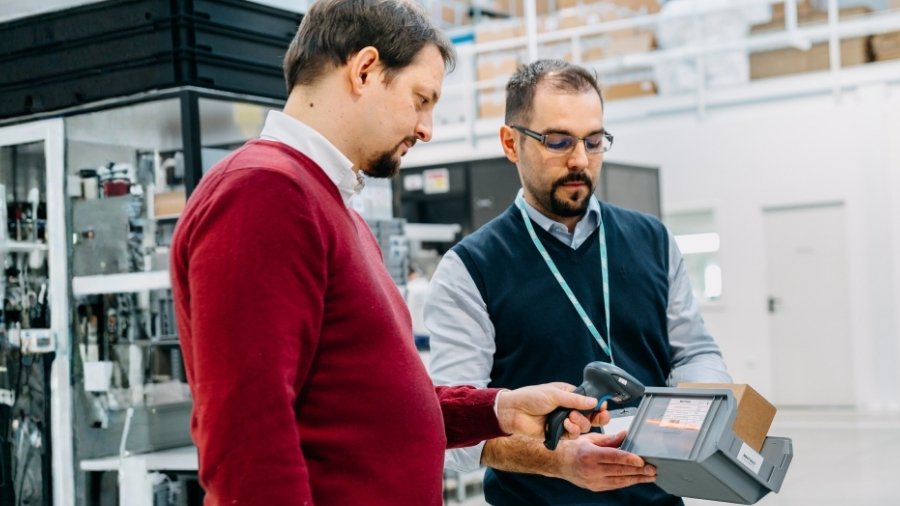
Practical examples of using both kanban and closed order logics in KanbanBOX
Mixed Procurement Activities
One of the most common use cases involves companies using KanbanBOX to manage procurement from external suppliers, adopting different management methods depending on the component type.
- For repetitive components, the company operates in kanban mode: each supply is regulated by electronic kanban cards that accumulate digitally and release the order only when the agreed minimum quantity is reached.
- For non-repetitive components, on the other hand, a closed order is generated, with defined quantities and lead times.
Regardless of the management policy used, KanbanBOX makes the process completely transparent: the supplier, by accessing their digital board, can view all cards associated to order requests, those batching, and the customer’s updated stock levels.
Conversely, the supplier can use the platform to update the status of the cards, indicating which are in production or already shipped, allowing the customer to check their status directly in the system without sending emails or making phone calls.
As you can imagine, this means that with KanbanBOX, the information flow between supplier and customer is shared and immediate, making collaboration an integral part of an efficient, synchronized, and waste-free pull process.
Mixed Production Activities
Another practical example concerns companies that operate with a mixed production system, alternating kanban and closed order logics depending on the product type.
- For example, an organization might manage its high-demand finished products using a supermarket approach: every time an item is taken from the supermarket, a kanban production order is automatically triggered to replenish it, ensuring continuous availability of high-turnover products without excessive stock.
- For low-demand finished products, however, production is managed through closed orders, which are triggered only when a customer order arrives. In these cases, production can start from scratch or from a semi-finished product, depending on the process setup.
Thanks to this flexibility, the company can combine both methods within a single platform, optimizing flows and maintaining full consistency with Lean principles: producing only what’s needed, when it’s needed, with maximum visibility and control.
One platform for complete pull management
From kanban to closed orders, from procurement to production, from handling to sales, KanbanBOX brings together in a single platform all the operational modes that make truly integrated pull management possible.
Its strength lies in flexibility: the ability to adapt to the different needs of departments and suppliers while keeping the material flow always synchronized with real demand.
In this way, KanbanBOX is not just a digital tool, but a true enabler of Lean processes, capable of connecting people, departments, and companies in a transparent, responsive, and continuously improving production system.
Discover how you can upgrade your kanban and closed order management with KanbanBOX
Case studies
Sacchi | Electrical Supply Distribution
Sacchi uses KanbanBOX to offer its customers a kanban-based sales service, ideal for recurring supplies and supports long-term customer loyalty
Oleodinamica Marchesini | Hydraulic valves
Oleodinamica Marchesini has optimized its production flow management by implementing multi-process kanban and pull production
Robopac | Packaging machines
With KanbanBOX, Robopac achieved a more integrated, responsive, and digitalized supply chain thanks to the integration with both external suppliers and SAP
BCS | Agricultural Mechanization
BCS moved from push to pull through E-kanban for suppliers, production, and internal flows. They now manage 6000 kanban loops across 3 plants
El.Co. | Industrial Electrical Automation
El.Co. has simplified the maintenance of kanbans with e-kanban, which was previously so onerous that the number of parts managed by kanban had to be limited
Orotig | Welding Industry
Orotig has implemented sequential pull in the company, optimizing multi-process production scheduling and supplier integration with KanbanBOX
Rossi SpA | Gearmotors and Electric Motors
Rossi Spa has digitalized the existing production and move kanban, then integrated it with its own ERP, with Oracle Sequencer and with suppliers
Aptiv | High-tech automotive systems
From the introduction of kanban to the transition to e-kanban. The Lean Improvement journey of the largest manufacturer of electronic interconnection systems for the automotive sector
References