Integrate KanbanBOX with RFID Identification Technology
Achieve maximum efficiency and traceability through automation
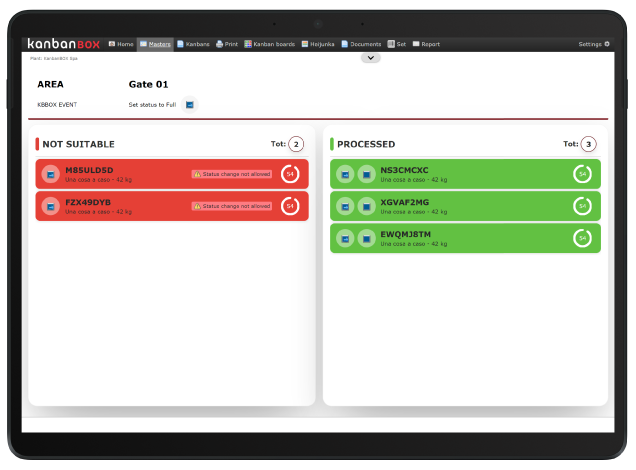
One of the main advantages of electronic kanban systems is the digitalization of material data, both consumed and to be replenished. This is made possible by adding barcodes or QR codes to kanban cards, which can then be scanned using dedicated reading devices.
This process represents one of the fundamental pillars of e-kanban systems and:
- Ensures a continuous, real-time data flow
- Eliminates low-value manual tasks, such as data entry
In most cases, scanning is performed by operators using portable devices such as handheld scanners, smart gloves, or smartphones. However, for companies aiming for maximum automation, it is possible to adopt RFID identification systems.
The Benefits of RFID Systems Integrated with KanbanBOX
Automate the flow
Automatically track material movement in real time, whether handled manually by operators or through automated transport systems
Eliminate scanning devices
Since tracking is performed automatically, you can say goodbye to barcode reading devices such as scanners, handhelds, or smartphones
Remove human error
By eliminating manual scanning, you not only increase operational speed and free operators from repetitive tasks, but also eliminate human error risks
What is an RFID System
An RFID (Radio Frequency Identification) system is a radio frequency tracking technology that enables the unique, automatic, and remote detection of moving objects.
Each system consists of:
- RFID Tags (Transponders), electronic labels equipped with a microchip that stores specific information about the tagged object.
- Readers (or Controllers), specialized devices that identify and monitor tags as they move, transmitting real-time data to management systems and KanbanBOX.
- Antennas, generate the magnetic field that activates the tag and enables radio communication between tag and reader.
A well-designed network of readers and antennas defines RFID Areas, zones where the system records the entry, passage, or exit of RFID tags (including direction of movement), and therefore of the materials to which they are attached.
Applications and Benefits of RFID Technology
RFID technology has many applications in industrial, logistics, and material-handling environments.
With RFID systems, you can track:
- Material entry and exit from one or more company or plant areas, even across multiple sites or partner facilities (Intra- and Inter-Company RFID).
- Material picking from shelves, containers, or areas.
- Material placement in containers (e.g., empty box racks) or storage zones.
- Movement through gates or checkpoints, detecting direction (inbound/outbound).
- Both small and large quantities, from individual components or bins to pallets and containers.
- Tags of different shapes, coatings, and materials, suitable for harsh environments (heat, humidity, chemicals, dust).
- Hidden tags, for instance inside packaging (non-metal), without requiring optical visibility or orientation.
- Production line flow, enabling automatic material flow control within manufacturing units.
From Theory to Practice: the AGCO Case Study
AGCO Spa, a leading agricultural machinery manufacturer, wanted to automate the mass update of kanban card statuses at its Gold Harvesting site in Italy.
To achieve this, a custom RFID system integrated with KanbanBOX was developed, allowing the company to improve material flow precision and efficiency, benefiting both the business and its operators.
Read the AGCO Case StudyLearn more about how RFID systems works and advantages
RFID (Radio Frequency Identification) technology enables the automatic identification and tracking of objects, materials, or components using radio waves, with no need for direct contact or optical scanning.
In our in-depth article, we explain how RFID works, its key components, and how it can be integrated with e-kanban software to make material flow management even more efficient.
Read the full article
Integration between RFID technology
and KanbanBOX
By integrating KanbanBOX with RFID systems, you enable automatic material tracking, reaching the highest level of pull flow optimization and Supermarket replenishment automation.
Thanks to seamless integration, material movements are tracked effortlessly: when a tagged item passes through an RFID area, the system instantly recognizes the item and its movement direction, sending the related data directly to KanbanBOX.
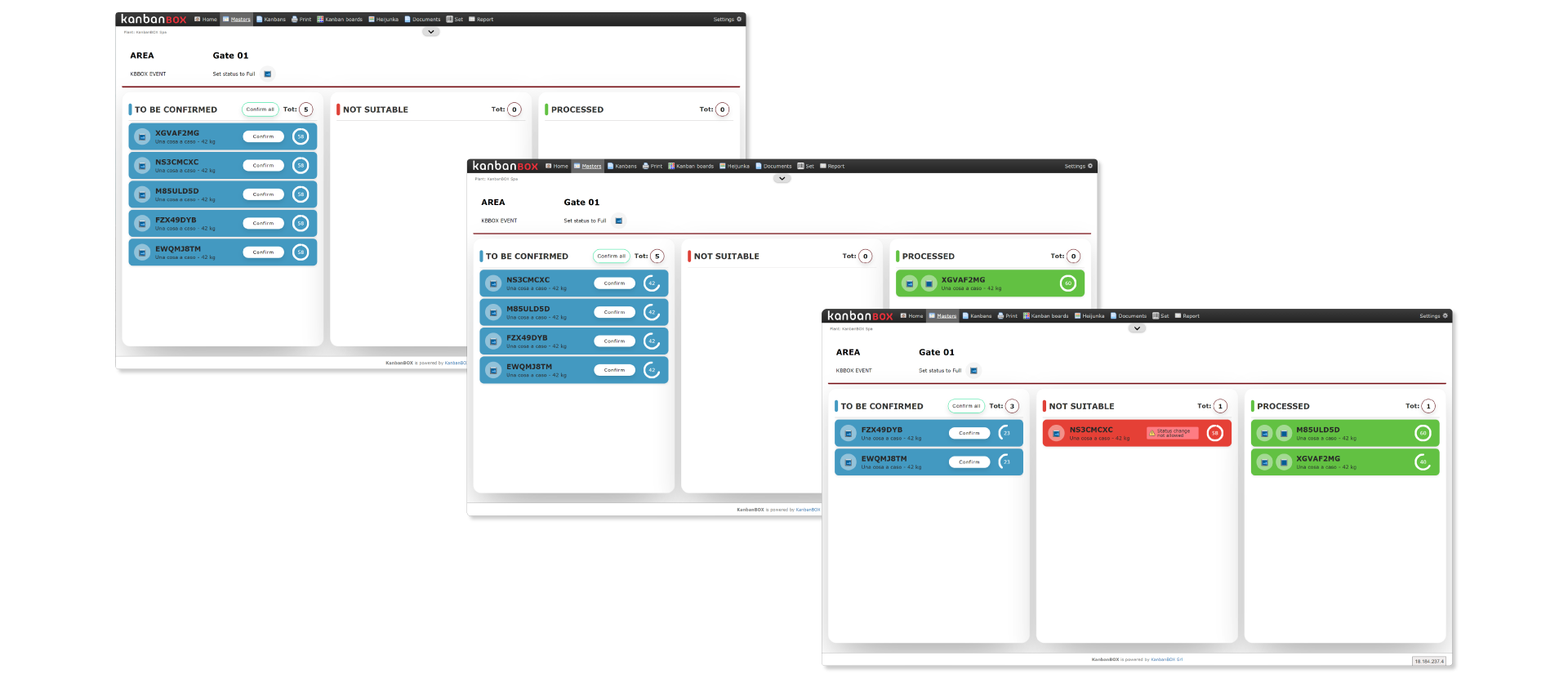
Managing RFID Systems in practice: the RFID Module
To manage the configured RFID system, KanbanBOX provides a dedicated.
With the KanbanBOX RFID Module, you gain:
- Simplified integration
- Full, real-time visibility of material flow
- Automatic real-time data updates from the RFID system
- Control dashboards with automatic or manual confirmation options
- Technical support from our expert team
- Precision and automation in process planning and execution, achieving full material flow automation.
Beyond RFID: Automated Warehouses and AGVs
By integrating Automated Warehouse (WMS) systems, Warehouse Management software, and Automated Guided Vehicles (AGVs), you gain full visibility of material movements and reduce transport-related costs.
Learn moreKanbanBOX and Digital Innovation for the Smart Factory
Industry 4.0 represents the manufacturing model of the future. Thanks to Smart Technologies, companies can become increasingly connected, enhancing collaboration between people, assets, knowledge, and information, extending digital efficiency across the entire value chain.
Discover moreDo you have any questions? Contact us!
We are ready to give you all the answers about KanbanBOX and RFID
Case studies
Sacchi | Electrical Supply Distribution
Sacchi uses KanbanBOX to offer its customers a kanban-based sales service, ideal for recurring supplies and supports long-term customer loyalty
Oleodinamica Marchesini | Hydraulic valves
Oleodinamica Marchesini has optimized its production flow management by implementing multi-process kanban and pull production
Robopac | Packaging machines
With KanbanBOX, Robopac achieved a more integrated, responsive, and digitalized supply chain thanks to the integration with both external suppliers and SAP
BCS | Agricultural Mechanization
BCS moved from push to pull through E-kanban for suppliers, production, and internal flows. They now manage 6000 kanban loops across 3 plants
El.Co. | Industrial Electrical Automation
El.Co. has simplified the maintenance of kanbans with e-kanban, which was previously so onerous that the number of parts managed by kanban had to be limited
Orotig | Welding Industry
Orotig has implemented sequential pull in the company, optimizing multi-process production scheduling and supplier integration with KanbanBOX
Rossi SpA | Gearmotors and Electric Motors
Rossi Spa has digitalized the existing production and move kanban, then integrated it with its own ERP, with Oracle Sequencer and with suppliers
Aptiv | High-tech automotive systems
From the introduction of kanban to the transition to e-kanban. The Lean Improvement journey of the largest manufacturer of electronic interconnection systems for the automotive sector
References