Interview with Marco on his 10th Anniversary at KanbanBOX
Some milestones are external: new customers, new markets, revenue goals. Others are deeply personal. Among these, we recently celebrated Marco Andriolo-Stagno’s 10-year anniversary at KanbanBOX!
To mark this special occasion, we interviewed Marco, who shared with us what it means to have worked at KanbanBOX for over 10 years and how he personally witnessed the company’s growth, from “4 guys in a room” to a team of 45 people.

Marco, for those who don't know you, what do you do at KanbanBOX?
My email signature says “Security and Infrastructure Manager.” Basically, I take care of security, both information and infrastructure, a role that in the past would have been called “System Administrator.” I’m also a DevOps, a hybrid role between development and infrastructure that focuses on automating processes to deploy code online.
I joined KanbanBOX as a system administrator and developer, but as the team grew, I gradually shifted away from coding to focus more on security. Among the significant tasks I’ve been involved in, besides the highly technical and delicate infrastructure management work, I led the entire process required for the ISO/IEC 27001 Certification (Information Security Management Systems), achieved in our first year with zero non-compliance, a rare accomplishment for a first certification. It was incredibly satisfying.
How did you meet the founding partners of KanbanBOX?
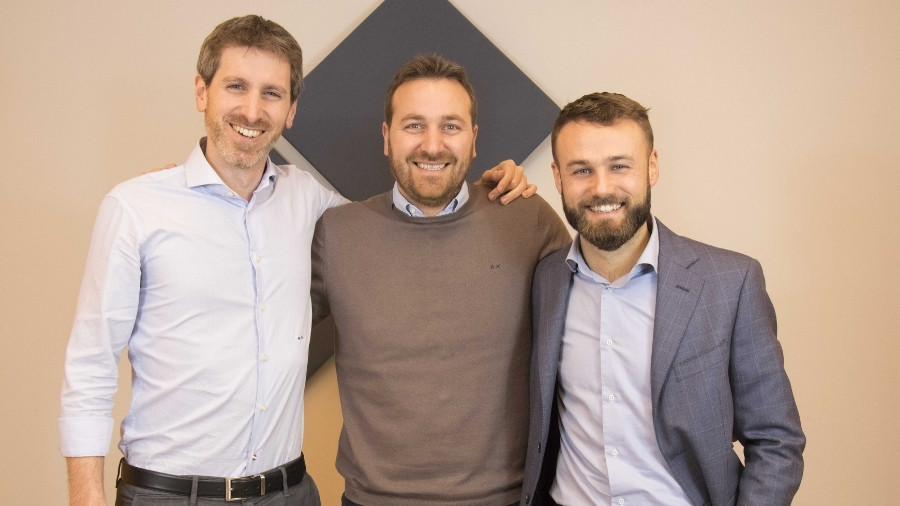
I met them through a mutual contact, Leonardo. It was 2012, and I had just started my freelance business. He knew I was looking for clients and also that Matteo Biagini [co-founder of KanbanBOX alongside Guido Bonuzzi and Francesco Dall’Oca] was looking for someone with my expertise, so he connected us.
I met Matteo and Guido at a pub. At the time, I had no idea what kanban was, and even after their explanations, I have to admit I didn’t understand much. But the IT project was interesting.
That’s when I started collaborating as a freelancer. Initially, I focused mainly on infrastructure: servers, virtual machines, and databases. Then, I also got involved in writing the software code, which up until then had been handled by Matteo and Guido, while Francesco focused on the commercial side.
At that time, KanbanBOX was a start-up: what convinced you to get involved with the project?
Definitely the people. It was clear they were talented and had a clear vision. Most importantly, they were serious about the project. This impression was also confirmed by our mutual connection.
The fact that it was a start-up didn’t bother me; on the contrary, I’ve always liked these environments. They’re more challenging, and there’s no “we’ve always done it this way.” You can propose ideas, experiment, and follow projects from start to finish, seeing them evolve and produce results.
That’s also why I wrote many parts of the Legacy code for KanbanBOX. The code has been improved and optimized over time, but much of it is still in place.
After a few years of freelance collaboration, one evening the partners invited me to meet at a pizzeria. There, they offered me a full-time position. So, in January 2016, I officially became KanbanBOX’s first employee.
A few months later, I was already at a trade show with the partners and an external consultant. They were all in suits with red ties, and I was wearing a sweater. Officially because an IT manager in a suit was less credible, but honestly, I had no intention of dressing too formal like that!
Do you have any anecdotes from the early days when there were only four of you?
Sure! As often happens in start-ups, we initially faced some market skepticism because we were such a small team. I remember a video call Matteo had with a potential international client while we were all four in the office, which was just one room at the time.
He was introducing KanbanBOX at two people: the Lean Manager, enthusiastic about the software and its functionality, and the IT Manager, much more cautious.
He was so cautious that, at the end of the meeting, he said he couldn’t tell whether we were a structured company or, in his words, “Four guys in a room.”
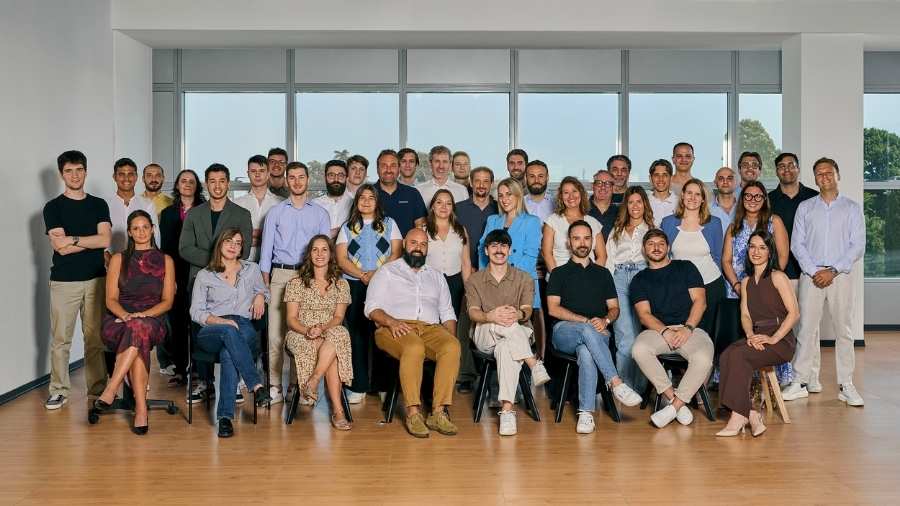
The fact that he perfectly described our situation made us laugh. We didn’t win that client, but over time, those “four guys in a room” grew to 45 people.
How did you experience the growth of KanbanBOX from 4 to 45 people?
It was great because the growth was well managed. Initially, it was very gradual, one or two people a year. Among them there was Davide Bicego, whom I mentored when he started as an intern. Today, after 8 years with the company, he leads the development team of 12 people. [See Linkedin post]
The most significant increase happened after 2020, but I think the real turning point came with the arrival of Serena Giordano. By that time, two new developers had joined (four in total), we had just moved into a new office (with meeting rooms and separate workspaces), and with Serena’s arrival, administration and HR tasks were no longer handled “as needed” by the partners, which allowed the company to start structuring itself.
Moreover, having someone dedicated to recruiting allowed us to manage the selection process better, ensuring that we hired people who were aligned not just with the required skills, but also with the company culture.
It’s also worth mentioning that there’s a great atmosphere in the office, partly because of the many young people and partly because of the transparent and informal management.
After all, if it wasn’t like that, I doubt I’d still be here after 10 years!
When you talk about well-being and company management, do you refer to the self-management principles implemented at KanbanBOX?
Kind of: from the beginning, there has always been a lot of freedom among collaborators in managing their tasks, although this freedom wasn’t formalized.
For example, a simple but concrete case: if there are no urgent tasks or priorities, developers are free to choose what to work on within the software. It was like that from the start, and it’s still the same today.
As the company grew, we started giving a clearer structure to this approach until we discovered the self-management principles promoted by the SEMCO Style® Method. At that point, we realized that many of the practices promoted by this method were already in place at KanbanBOX, we just needed more structure and a name to define them.
Has the company’s focus on training also been part of the culture from the beginning?
Absolutely. While today the training incentive is more structured, with an annual budget for each employee, there’s always been a strong push for training and innovation in the company.
The choice of courses has always been driven not only by the company’s needs but also by the professional aspirations of the employees, which often aligned perfectly.
For instance, when I started, I knew very little about the cloud technologies KanbanBOX was (and still is) based on. I learned a lot from Guido and Matteo, but also through self-study and training courses. Sometimes it worked the other way around: I would get interested in a topic, only to realize later that it would be useful for the company.
In addition to training, the company often organizes workshops. Is there one that particularly impressed you?
Probably because I’m biased, but the workshop that left the most lasting impression on me was the improvisational theater workshop [see Linkedin post], which I helped organize by involving a teacher with whom I had done courses in the past.
It impressed me because I saw colleagues who were initially skeptical or shy (think of the classic introverted developer stereotype) get fully involved, even competing to take the stage. It was a fun and effective team-building activity that also developed important soft skills.
Is there any tradition in KanbanBOX that you’ve helped start and has continued over time?
Yes, bringing pastries or other treats to share for your birthday with colleagues. Over time, this tradition extended to celebrate important milestones like graduations, new hires, weddings, or new births, sometimes even arranged collectively by colleagues.
That’s why, in January, my colleague Ioana Huluta and I brought in a huge Nutella cake to celebrate our anniversaries at KanbanBOX: hers three years, mine a bit more.
What does reaching your 10th anniversary at KanbanBOX mean to you?
It’s an important milestone, especially because it’s the longest I’ve ever stayed at one company. For the occasion, the partners and Serena organized a thank-you moment with photos and stories from these ten years, including the famous photo of me in a sweater at the trade show. I really appreciated it.
The thing that surprises me the most, though, is that it doesn’t feel like ten years have passed. Everything still feels dynamic: new people, new offices, new challenges.
So, here’s to the next ten years!
Discover more about how it started
Read the interview with Matteo, Guido, and Francesco about the early days of KanbanBOX