10 Criteria for Choosing an E-Kanban Software Provider
Choosing an e-kanban software provider is not simply a matter of comparing software features. Digitizing kanban affects production and logistics processes, people, IT systems and, in many cases, external suppliers and customers.
If you are looking for a company to digitize your kanban system, an e-kanban software provider, or a specialized electronic kanban partner, you should evaluate not only what the software can do today, but also whether the provider can support the evolution of your system over time.
Here are 10 criteria to consider when choosing an e-kanban software provider.
1. Types of material flows supported
Not all e-kanban solutions support the same types of flows. Some are designed mainly for internal kanban, such as production kanban or material replenishment between a warehouse and the production line. Others can extend the system to suppliers, customers and contract manufacturers through purchasing and sales kanban.
You should also check whether the software can manage dependencies between different processes, such as multi-stage kanban, and whether kanban and non-kanban flows, such as Make to Order (MTO), can be managed within the same platform.
Choosing a flexible solution allows you to address your current requirements without having to replace the system as the number and complexity of your digital material flows increase.
2. Level of integration with suppliers, customers and external partners
If your kanban system involves external partners, it is important to understand whether and how deeply they can be integrated into the platform.
Some solutions simply send notifications or orders. Others allow suppliers, customers and contract manufacturers to participate directly in the process, view replenishment signals, confirm activities and share real-time information.
You should also verify whether external users require additional paid licenses. This can have a significant impact on partner adoption and on your ability to extend electronic kanban across the entire supply chain.
3. ERP integration without ERP dependency
The ability to integrate e-kanban software with your ERP is important because it can automate data exchange, reduce manual activities and avoid duplicate data entry.
At the same time, ERP integration should not necessarily be mandatory from day one. Ideally, the e-kanban system should be able to operate independently, allowing you to decide whether and when to integrate it with your ERP.
It is also important to avoid becoming overly dependent on a specific ERP. Your e-kanban system should be able to remain in place even if your company changes ERP in the future, preserving the material flow processes and system structure you have already built.
4. Implementation time and go-live support
An e-kanban system should not require a long and complex IT project before you can start using it.
When evaluating a provider, consider how quickly a first flow can become operational and what type of support is available during configuration, testing and go-live.
Being able to start with a limited pilot in just a few days can help you validate the system, involve shop-floor operators and then gradually extend electronic kanban to additional materials, processes and departments.
5. Lean expertise
Digitizing kanban is not simply about a digital kanban signal.
The provider should also understand Lean principles and pull systems, so that the implementation approach can be adapted to your company’s level of Lean maturity.
A good onboarding process should support both companies that already have a manual kanban system and want to digitize it, and companies that are still operating with traditional push-based planning and need help designing supermarkets, kanban sizing, replenishment rules and operational responsibilities.
6. Scalability and support for expansion
An e-kanban project may begin with one production line, one department or one supplier and later expand to additional processes.
For this reason, it is important to evaluate the scalability of the platform from the beginning. The software should allow you to add new departments, plants, companies and intercompany flows without rebuilding the system from scratch.
A scalable e-kanban solution allows you to start small while maintaining the option to create a common material management standard across multiple plants or companies in the future.
7. Help desk and user support
Support remains important even after go-live.
Check whether the e-kanban software provider offers online guides, updated documentation, a ticketing system and technical support that users can easily access when needed.
A well-structured help desk reduces dependence on individual consultants, helps users solve common issues quickly and makes it easier for the organization to manage the platform independently over time.
8. Information security standards
E-kanban software manages information related to production, suppliers, orders and material movements and can become an integral part of daily manufacturing operations.
For this reason, you should evaluate data security, access management, cloud infrastructure, backups and the security certifications adopted by the e-kanban software provider.
Recognized international standards and formal security procedures provide objective criteria for assessing how seriously a provider approaches information security.
9. Reliability and long-term service continuity
The reliability of an e-kanban system should also be evaluated from a long-term perspective.
In addition to technical performance, consider how long the solution has been in use, how many companies rely on it and whether the e-kanban software provider can show real customer implementations and case studies.
The subscription model can also provide useful information. When customers are free to discontinue the service without being locked into long-term contracts, their decision to continue using the platform can be a stronger indicator of the value and reliability of the solution.
10. Integration with WMS, RFID, electronic labels and new technologies
Your digitalization requirements are likely to evolve over time.
A system that initially relies on standard technologies may later need to connect with WMS platforms, RFID, electronic labels, automated identification systems or other smart manufacturing technologies.
Choosing a platform that is not tied to one specific technology gives you the flexibility to introduce new tools gradually while keeping the same e-kanban system and material flow structure.
Looking for a company to digitize your kanban system?
When choosing an e-kanban software provider, geographic proximity should not be a key factor. Today, material flows and existing processes can be analyzed effectively through video calls, screen sharing and shop-floor videos, making it possible to design and configure the system remotely.
What matters more is the reliability and functionality of the software, the provider’s Lean expertise and its ability to support the project over time. At the same time, the provider should be able to send experienced specialists on site when needed, especially for a short go-live phase, operator training or final implementation support.
In other words, it is more important to choose the right e-kanban software provider than the closest one: look for a provider that can work efficiently remotely and still offer on-site support anywhere it is required.
That’s why KanbanBOX, an Italian kanban software, is used by manufacturing companies around the world, from the United States to Australia, and from Japan to Brazil, supporting e-kanban projects across different industries, plants and supply chain environments. This international experience allows KanbanBOX to combine remote implementation capabilities with on-site support whenever it adds value during go-live.
KanbanBOX as an e-kanban software provider
KanbanBOX srl is an Italian e-kanban software provider specializing in the digitalization of pull-based material flows. The platform, KanbanBOX, supports purchasing, production, material handling and sales kanban, as well as Make to Order processes, and can directly connect suppliers, customers and contract manufacturers.
KanbanBOX can operate independently or be integrated with ERP, MES, WMS and other technologies. Integration can also be introduced at a later stage, without making the e-kanban system dependent on a specific ERP.
The software is developed and managed by a team of technical and Lean experts who support companies throughout implementation, whether they are digitizing an existing manual kanban system or building a pull system from scratch. The platform can then be progressively expanded across additional production lines, departments and manufacturing plants.
KanbanBOX also provides an online help center and technical support, is ISO/IEC 27001 certified for Information Security Management, and can integrate with technologies such as RFID and electronic labels, allowing the system to evolve as manufacturing requirements change.
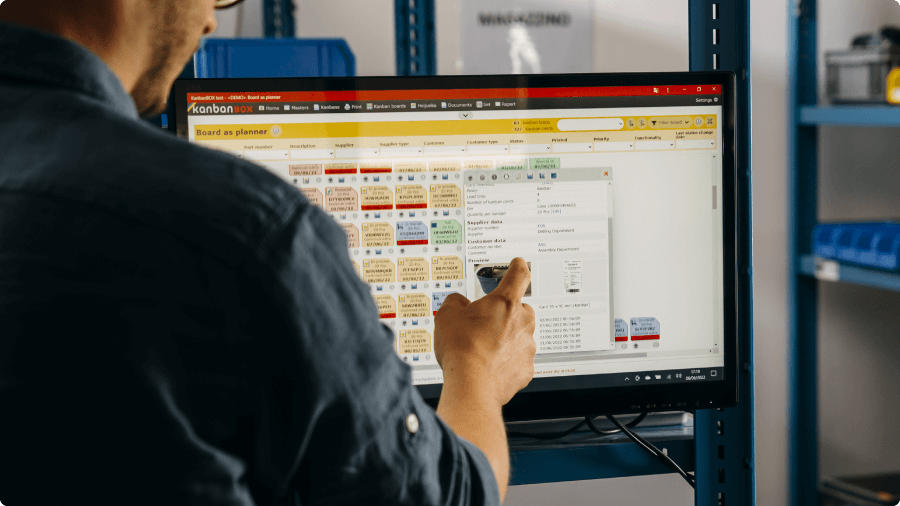
Are you evaluating an e-kanban solution?
Fill the form at the end of this article and tell us how you currently manage your material flows. We can help you identify which processes can be digitized and which implementation approach best fits your organization.
Frequently Asked Questions About Choosing an E-Kanban Provider
How do I choose an e-kanban software provider?
Look for a partner that combines Lean expertise and software capabilities, implementation support, integration with enterprise systems, supply chain collaboration capabilities and the ability to scale as your requirements evolve.
What should good electronic kanban software provide?
In addition to digitizing consumption and replenishment signals, a good electronic kanban solution should support kanban sizing and maintenance, traceability, supplier and customer collaboration, ERP/MES/WMS integration, multi-plant environments and, where necessary, non-kanban material flows.
Are there companies specialized specifically in electronic kanban?
Yes. Some providers specialize specifically in e-kanban and Lean Material Management, rather than offering kanban as one feature within a broader software suite. KanbanBOX, for example, is an Italian company specializing in electronic kanban software, with its software developed internally in Italy and used for international implementations.
Is it better to choose an e-kanban specialist or a general software vendor?
In most cases, working with a company specialized in electronic kanban provides an advantage. A general software vendor may be able to develop a solution based on your specifications, but it may not have the same understanding of Lean principles, pull systems and the operational issues that emerge as the system evolves.
The result can be a more static solution designed primarily around the original requirements. A specialized e-kanban platform is more likely to evolve continuously based on experience gained across thousands of companies and to adapt to new processes, plants, integrations and material management requirements.
Should I choose a local or international e-kanban software provider?
Geographic proximity should not be a key factor when choosing an e-kanban software provider, as implementation can be effectively managed remotely through video calls, shop-floor videos, and remote support. More important criteria are the provider’s specialization, implementation expertise, software reliability, and long-term scalability. International manufacturing groups should also assess whether the solution can support multiple plants, countries, languages, and supply chain partners within a single platform, while still offering on-site support when needed for go-live or other critical implementation phases.
Does e-kanban software replace the ERP?
No. Specialized e-kanban software can work alongside the ERP, managing the operational execution of pull-based material flows while exchanging the necessary information with the enterprise system.
For this reason, it is important to evaluate both the provider’s integration capabilities and whether the e-kanban platform can operate independently from the ERP.
Evaluating an e-kanban solution?
Tell us how you currently manage your material flows. We can help you identify which processes can be digitized and determine the most appropriate implementation path for your organization.