Value Stream Map and E-Kanban: The Winning Combination
Why E-Kanban is a Valuable Ally in Implementing Your Future Value Stream Map
When a company decides to redesign a production or distribution process to make it efficient and waste-free, the first essential step is to have a clear vision of how the process is currently functioning and how it is desired to function in the future.
To achieve this, companies often use the Value Stream Map (VSM), a mapping tool designed to frame and analyze all the processes within the entire value flow being studied, both physical (e.g., the processing or movement of a component) and informational (e.g., the transmission of a production order).
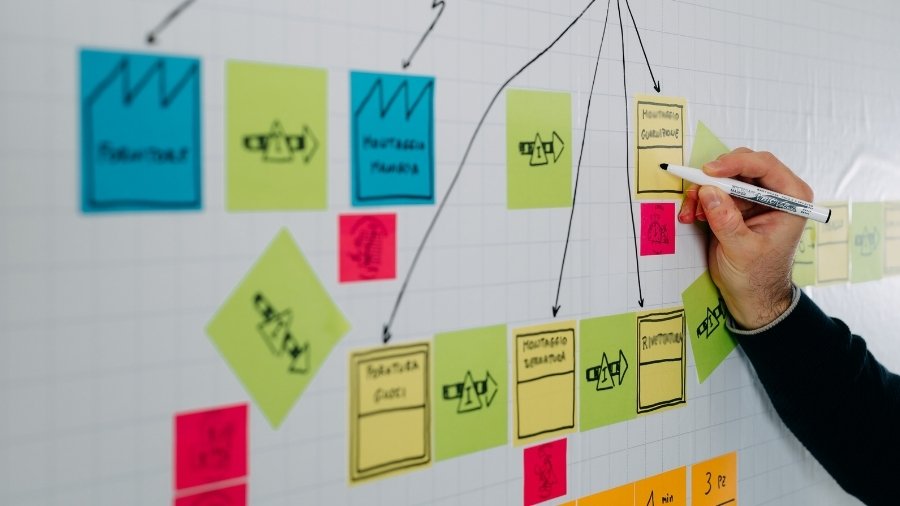
The Value Stream Map can be of two types:
- Current Value Stream Map: a “snapshot” of the current state of the value flow
- Future Value Stream Map: the representation of the ideal flow, the final goal of the redesign of the analyzed production process.
Transitioning from the Current Value Stream Map to the Future Value Stream Map and then implementing the activities required to reduce waste and streamline the process can be challenging. This is particularly true for companies relying on manual processes for inventory management and replenishment.
This is where electronic kanban can prove to be a valuable ally. By digitizing the informational flow of materials and automating replenishment processes, electronic kanban helps companies effectively implement their Future Value Stream Map, ensuring Lean improvements are both practical and sustainable over time.
Let’s explore how it works.
Optimizing Material Flows and Reducing Waste
One of the primary objectives of a Future Value Stream Map is to create a smooth material flow, eliminating delays, excess materials, and bottlenecks.
Electronic kanban supports this goal through the digitization of information, which allows companies to track inventory levels in real time and identify potential bottlenecks or issues and to automate the transmission of replenishment signals from the customer process to the supplier process, reducing errors and activities related to manual order management
This means that, thanks to electronic kanban, companies can:
- Have a clear, real-time view of inventory levels, dynamically adjusted based on actual consumption
- Prevent overproduction, as replenishment activities are initiated only after actual consumption, not based on future estimates
- Address the risk of stockouts, thanks to real-time order transmission and automatic calculation of optimal inventory sizing (also called kanban sizing)
- Optimize material flow according to demand fluctuations, maintaining a just-in-time (JIT) system
- Reduce lead time: orders are transmitted in real time, avoiding delays that could cause stockouts and operational interruptions.
Supplier Integration
Many companies designing their Future Value Stream Map aim to reduce lead times and improve collaboration with suppliers. However, if order transmission is handled manually (via emails, phone calls, or spreadsheets), achieving a smooth supply chain flow becomes difficult.
Electronic kanban allows companies to integrate suppliers into their material management system, enabling them to:
- Automate the transmission of recurring orders to suppliers once specific stock levels are reached
- Standardize and speed up order management, both for kanban orders and closed orders
- Centralize communication with suppliers in one platform, with the ability to add comments or negotiations related to individual orders
- Eliminate non-value-added activities, such as manually checking inventory levels or sending follow-up requests
By integrating suppliers into their material management system, companies ensure that their Future Value Stream Map is not just a theoretical goal, but an effective, waste-free, and sustainable operational system.
Process Visibility and Continuous Improvement
An effective Future Value Stream Map requires a continuous monitoring system that allows companies not only to keep the status of processes under control but also to intervene in case of problems or anomalies, as well as pursue continuous improvement.
Electronic kanban allows companies to access performance data and metrics, enabling them to:
- Eliminate manual tracking activities and errors, replaced by automatic tracking managed by the electronic kanban system
- Track the status of all kanban cards in real time, providing a clear overview of both inventory levels and process progress
- Identify potential bottlenecks that require immediate intervention
- Always have access to updated operational data, such as the new lead time calculated after a production delay
- Monitor the punctuality of supplier deliveries to assess their reliability
- Gain insights to identify opportunities for improvement.
Instead of relying on periodic manual audits, companies using electronic kanban can continuously refine their processes, ensuring that their Future Value Stream Map remains optimized over time.
Scalability and Standardization
Many companies struggle to implement their Future Value Stream Map across multiple sites or departments.
Electronic kanban provides a standardized and scalable solution that ensures the principles of the Future Value Stream Map are implemented consistently across all facilities.
With cloud-based platforms and centralized data management, companies can:
- Easily expand their electronic kanban system to multiple plants and sites
- Grow gradually by expanding the system at their own pace and according to their needs
- Achieve process standardization, reducing variability in supply chain performance.
Electronic Kanban as an Enabler for the Future Value Stream Map
Implementing a Future Value Stream Map requires more than just a well-designed map: companies need the right tools to support continuous improvement and Lean execution.
By adopting electronic kanban, such as KanbanBOX, companies can bridge the gap between strategy and implementation and efficiently transition from where they are today to where they want to be, ensuring that their Future Value Stream Map is not just a vision, but a practical and sustainable operational model.
Do you want to implement an effective Future Value Stream Map?
Our experts are ready to support you