Electronic move kanban: what it is and key use cases
What is electronic move kanban?
Electronic move kanban (or move e-kanban) is a system companies use to organize material transfers either within the factory, for example, from the central warehouse to the production line or between two lines, or between geographically distant warehouses, such as from an off-site warehouse to an internal one.
Compared to the non-digital version, simply called move kanban (also known as internal kanban, logistics kanban, transfer kanban, or transport kanban), the electronic move kanban relies on dedicated e-kanban software, enabling all the advantages of digitalization to manage material transfers efficiently, safely, and in a controlled way.
How electronic move kanban works
The mechanism is simple: every time a workstation or warehouse depletes a material and needs replenishment, the operator scans the move kanban card attached to the empty container, signaling to the software that the item has been depleted.
The software then generates a digital transfer request, directing it to the operator in charge of material movement.
By accessing the system’s digital board, the operator can instantly see what must be moved, in what quantity, in which container, and to which location, enabling fast and standardized execution.
The benefits of digitalization in move kanban
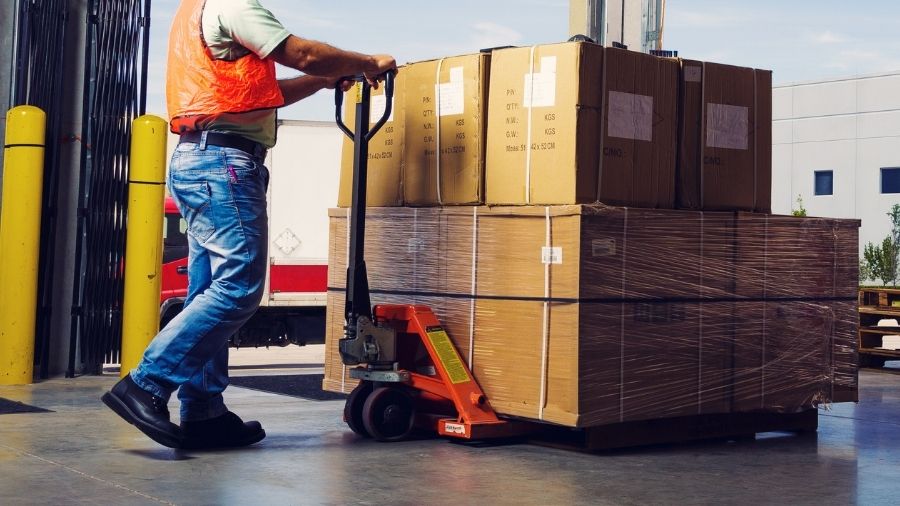
In a non-digital move kanban system, the material transfer request is triggered by physically handing over the paper card (removed from the empty container) to the operator responsible for the replenishment.
The kanban card displays all essential information needed to carry out the transfer, such as item code, standard quantity, container type, who must replenish it, and where it must be delivered.
With electronic move kanban, all this information (and its transmission) is digitized, bringing important advantages for the organization and its personnel.
Elimination of manual card delivery
With e-kanban, physical cards no longer need to be carried from one workstation to another, because the replenishment signal travels digitally.
When an operator empties a container, he/she simply scans the barcode on the card using a handheld scanner or mobile device.
The scan records the consumption, instantly sends the replenishment request to the responsible operator’s digital board, and eliminates unnecessary personnel movement as well as the risk of lost or damaged cards, which could otherwise lead to missing replenishments or operational downtime.
Complete data collection and traceability
The software tracks all system information and allows operators to consult it at any time.
Material status, recent transfer requests, requested component details, quantities, container types, and full movement history are available on the digital board, ensuring an orderly, transparent, and fully traceable replenishment process.
Multiprocess sequences
The software can generate sequences of move kanbans to manage transfers across multiple steps of the production flow.
For example, imagine a scenario where Daniel, an assembly cell operator, requests a preassembled kit that must be prepared by Julia in a dedicated kit-preparation cell located far away.
When Daniel requests the kit, the system immediately generates all the necessary move kanbans to transfer individual components from the central warehouse to Julia’s workstation.
As soon as Julia reports the kit as ready, the software automatically activates the preconfigured move kanban card needed to transport the completed kit back to Daniele.
This move kanban card was created in advance but kept “on hold” to avoid confusion for the logistics operator, who would otherwise see a transport request for an item not yet available.
This digital coordination allows the entire flow, from initial component movement to final kit delivery, to operate smoothly without manual planning, reducing errors, waiting times, and coordination efforts.
Information chaining
The software can automatically manage complex links between data contained in different kanban cards.
For example, when handling perishable materials, the operator no longer needs to manually identify the lot with the earliest expiration date. The software indicates the exact storage location of the correct item, using expiration information recorded during receiving or production.
Electronic move kanban and milk-run
Electronic move kanban enables companies to set up milk-run material collection activities.
A milk-run is an organized method in which an operator follows a predefined route to pick up and deliver materials to multiple production lines efficiently.
Without a milk-run, operators typically move in response to requests as they arrive, often revisiting the same areas multiple times and ignoring opportunities to combine nearby picks.
With milk-run, the software indicates the optimal pick-up and delivery sequence based on priorities and the capacity of the logistics cart or tugger train.
The result is more efficient picking, shorter routes, and greater punctuality in supplying production stations.
Integration with WMS, automated warehouses, AGVs, and RFID
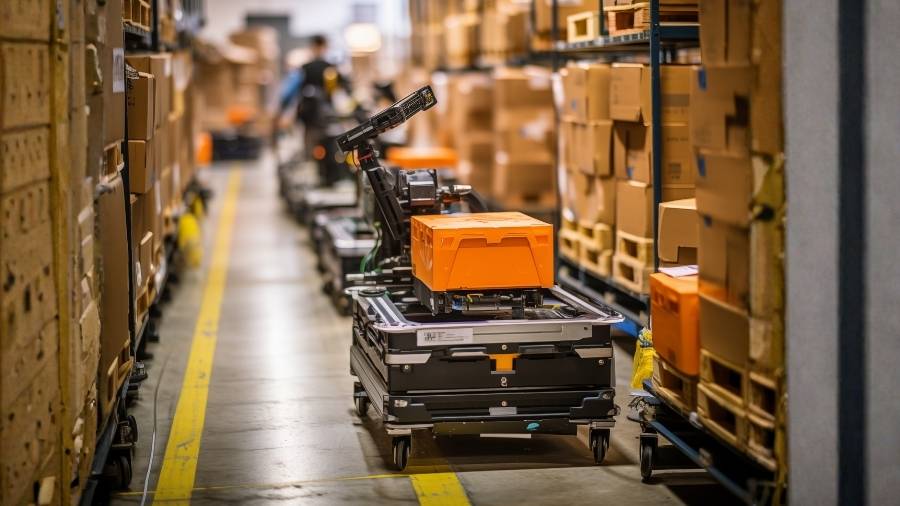
To further optimize material handling, electronic move kanban can integrate not only with common company systems (e.g., ERP) but also with WMS, automated storage systems, AGVs, and RFID technologies, enabling increasingly intelligent and autonomous logistics flows.
Today it is already possible to connect move requests to storage or picking systems, send automatic transport commands to AGVs, or record material movements via RFID gates.
These integrations, deployable immediately or in future phases, allow companies to progressively evolve toward leaner, more reliable, and more automated internal logistics.
Use cases of move e-kanban: examples from case studies
Below we share a collection of practical use cases of move e-kanban.
- Replenishing the production line from the central warehouse
One of the most common scenarios. For example, Orotig, a company specializing in laser technology, uses the system both for replenishing line-side supermarkets and for moving bulky materials that cannot be stored in supermarkets.
[See Orotig case study]Another example is AGCO, a leader in agricultural machinery, which enhanced the process by integrating RFID technology.
[See AGCO case study]
- Movement between departments or production lines
Used to move semi-finished goods or components along different phases of production. BCS, a manufacturer of agricultural machines, implemented move kanban in all three of its plants.
[See BCS case study] - Transfer between off-site warehouse and the internal warehouse
Common in companies with limited central warehouse space or bulky materials.
For instance, Gilbarco, which manufactures fuel dispensers, operates with an off-site warehouse located a few kilometers from its main plant.
[See Gilbarco case study]
- Movement of perishable materials or FIFO management
Critical for those handling perishable goods. Centre Oscar Lambret, a French hospital, uses move kanban to streamline drug transfers from the central pharmacy to department cabinets.
[See Centre Oscar Lambret case study] - Movement from production plant to company-owned retail store
Hiro Design, a furniture manufacturer, uses move kanban to replenish sold items at its company-owned store located several kilometers from the production site.
As these examples show, processes managed via move kanban can take many forms depending on operational needs.
This is why companies should not underestimate its role within production and logistics flows.
By adopting electronic move kanban, organizations can unlock significant improvements in speed, efficiency, and flow continuity, ensuring that materials always arrive where they are needed, when they are needed, with minimal operational effort.
Do you have any questions?
Case studies
Sacchi | Electrical Supply Distribution
Sacchi uses KanbanBOX to offer its customers a kanban-based sales service, ideal for recurring supplies and supports long-term customer loyalty
Oleodinamica Marchesini | Hydraulic valves
Oleodinamica Marchesini has optimized its production flow management by implementing multi-process kanban and pull production
Robopac | Packaging machines
With KanbanBOX, Robopac achieved a more integrated, responsive, and digitalized supply chain thanks to the integration with both external suppliers and SAP
BCS | Agricultural Mechanization
BCS moved from push to pull through E-kanban for suppliers, production, and internal flows. They now manage 6000 kanban loops across 3 plants
El.Co. | Industrial Electrical Automation
El.Co. has simplified the maintenance of kanbans with e-kanban, which was previously so onerous that the number of parts managed by kanban had to be limited
Orotig | Welding Industry
Orotig has implemented sequential pull in the company, optimizing multi-process production scheduling and supplier integration with KanbanBOX
Rossi SpA | Gearmotors and Electric Motors
Rossi Spa has digitalized the existing production and move kanban, then integrated it with its own ERP, with Oracle Sequencer and with suppliers
Aptiv | High-tech automotive systems
From the introduction of kanban to the transition to e-kanban. The Lean Improvement journey of the largest manufacturer of electronic interconnection systems for the automotive sector
References