Integrate KanbanBOX with Electronic Labels
For a Fully Paperless System
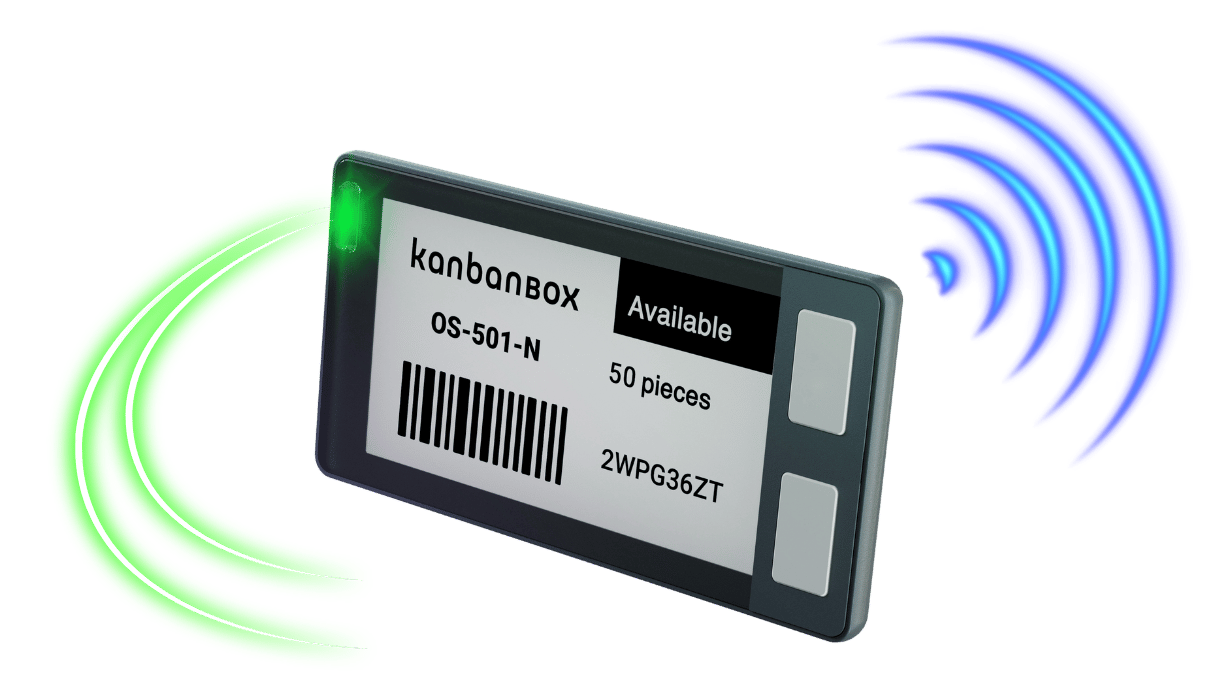
In traditional kanban systems, the paper card is the heart of the flow.
In electronic kanban systems, the paper card is supported by a tracked digital version within the software, synchronized and always up to date.
With the integration of KanbanBOX and electronic labels, the kanban card exists exclusively in digital format.
The result is a fully paperless electronic kanban system: highly dynamic and easy to manage.
Electronic Labels for E-Kanban Systems
Electronic labels are compact digital devices equipped with ultra-low energy consumption displays.
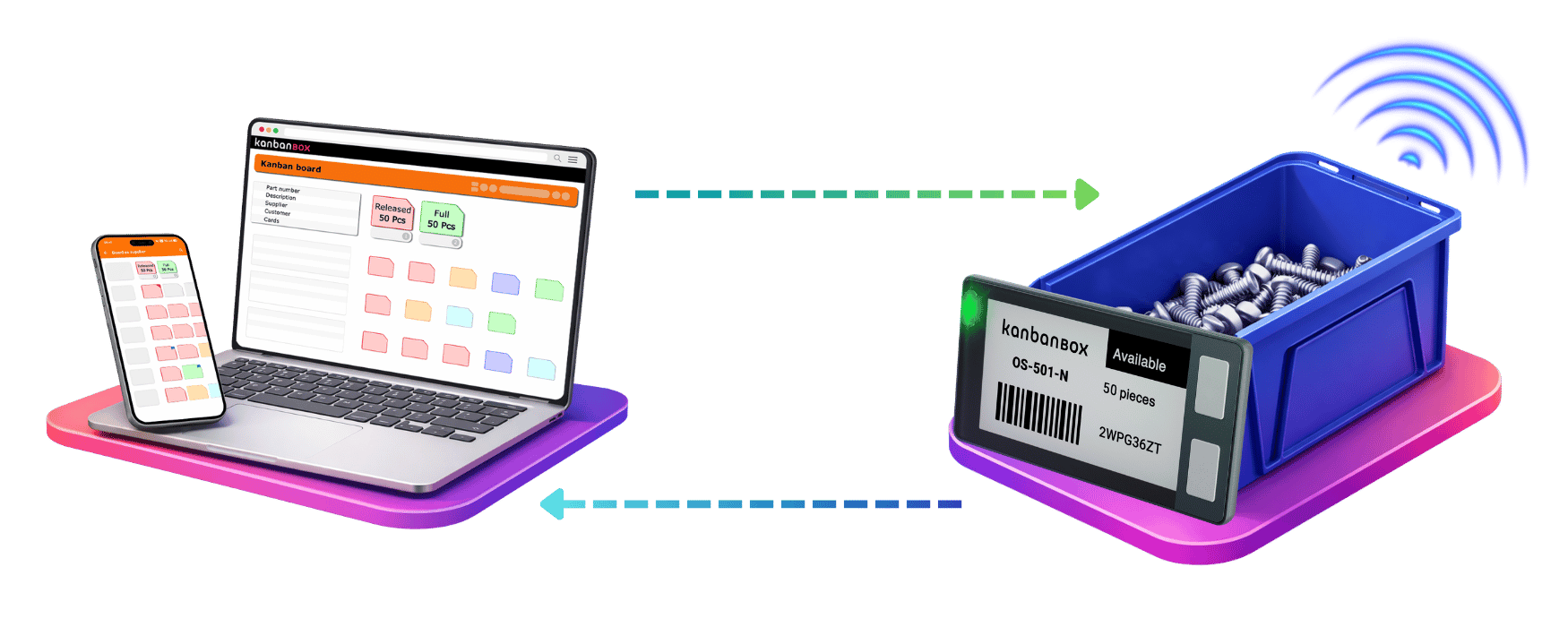
They replace the paper cards attached to the container, with one key difference: they are wirelessly connected to KanbanBOX.
This means that any change made to the digital card in the software (for example, a status update, quantity change, or priority adjustment) is automatically updated on the label in real time and in a centralized way.
As a result, the electronic label always displays the official data stored in the system, becoming the physical and visual extension of the software directly on the shop floor.
How the Integration Between KanbanBOX and Electronic Labels Works
- When material is ready for use, the electronic label attached to the container clearly shows the status “Available.”
- When the container is empty (i.e., “depleted”), the operator no longer needs to scan any barcode. To signal that the container has been emptied, they simply press the “Change Status” button directly on the label.
Within seconds, the information is transmitted to KanbanBOX, which automatically updates the digital kanban card and starts the replenishment process. - At the same time, the label dissociates from the closed card and becomes available again, ready to be reused and linked to a new card in just a few clicks.
- When material is replenished, the supplier takes an available label and associates it within seconds to the “To Be Replenished” card, making the new container immediately active and traceable in the system.
Goodbye Paper, Welcome Paperless
With the adoption of electronic labels, the paper disappears, along with all manual handling, from printing cards to their disposal
Automatic Data Updates
As material moves through the replenishment cycle, the label automatically updates to show its current status (e.g., Available, Processing, etc.)
Absolute Information Consistency
With a single digital kanban card, visible both on the board and on the electronic label, the data is unique, centralized, and official
The Benefits of Electronic Labels Integrated with KanbanBOX
- Change status with a single click directly from the electronic label, without using scanners, handheld devices, or barcode readers
- Eliminate paper cards: no printing, no physical handling
- Real-time data updates, ensuring cards are always aligned with system information
- Zero obsolete versions: the label always displays updated information, preventing “old” cards from circulating
- Visual signals: thanks to the built-in LED, priorities or anomalies can be highlighted immediately
Electronic Labels: Not Just a Support Tool, but a Technology Enabler
Integrated with KanbanBOX, electronic labels allow your company to explore and expand the use of advanced technologies, also evaluating their implementation at a later stage. These include:
- Pick to Light
Thanks to the integrated colored LEDs, operators can be visually guided during picking or replenishment activities. The correct container lights up, reducing picking errors, search time, and operational hesitation. - RFID Systems
KanbanBOX is already compatible with RFID systems to automate readings and status transitions. Electronic labels make this process even clearer and more visible on the shop floor, showing the updated label status in real time after automatic detection. - RTLS (Real-Time Locating System)
By integrating real-time locating systems, it is possible to track container positions along the production or logistics flow. The electronic label becomes the immediate access point to information, enabling faster material identification and drastically reducing search time.
From Paper to a Fully Paperless Solution
If your goal is to implement a truly paperless kanban system, electronic labels are the concrete solution.
This is not about evolving an electronic kanban system that already works, but about permanently eliminating paper, simplifying operations, and making the flow completely digital, while preserving the pull logic.
With electronic labels, you have a single kanban card, always updated, always consistent, directly on the container.
Ready to Adopt a 100% Digital E-Kanban System Without Paper Cards?
Request a demo and discover how to implement electronic labels integrated with KanbanBOX in your company.
Case studies
Sacchi | Electrical Supply Distribution
Sacchi uses KanbanBOX to offer its customers a kanban-based sales service, ideal for recurring supplies and supports long-term customer loyalty
Oleodinamica Marchesini | Hydraulic valves
Oleodinamica Marchesini has optimized its production flow management by implementing multi-process kanban and pull production
Robopac | Packaging machines
With KanbanBOX, Robopac achieved a more integrated, responsive, and digitalized supply chain thanks to the integration with both external suppliers and SAP
BCS | Agricultural Mechanization
BCS moved from push to pull through E-kanban for suppliers, production, and internal flows. They now manage 6000 kanban loops across 3 plants
El.Co. | Industrial Electrical Automation
El.Co. has simplified the maintenance of kanbans with e-kanban, which was previously so onerous that the number of parts managed by kanban had to be limited
Orotig | Welding Industry
Orotig has implemented sequential pull in the company, optimizing multi-process production scheduling and supplier integration with KanbanBOX
Rossi SpA | Gearmotors and Electric Motors
Rossi Spa has digitalized the existing production and move kanban, then integrated it with its own ERP, with Oracle Sequencer and with suppliers
Aptiv | High-tech automotive systems
From the introduction of kanban to the transition to e-kanban. The Lean Improvement journey of the largest manufacturer of electronic interconnection systems for the automotive sector
References