Producing with kanban system: meaning and benefits for manufacturing companies
What it means to produce with kanban system
Producing with kanban system means organizing manufacturing using the kanban method. This system manages production through the use of kanban cards, and it is activated not based on sales forecasts or rigid plans, but in response to actual market demand.
How kanban production system works
The flow for producing with the kanban method is based on a management system that connects manufacturing to actual demand through the use of kanban cards. To explain how it works, let’s imagine a company that manufactures metal lamps that need to be assembled, painted, and shipped.
Step 1: Receiving the finished product order
The company receives an order for a red lamp. This is a high-turnover product, so the company maintains a limited but stable stock of this product, stored in what is called the finished goods supermarket. The shipping operator takes the container with the red lamp from the supermarket and prepares it for shipment. Since that red lamp is no longer available in stock, it is technically considered “Depleted.”
Step 2: Taking the necessary kanban card to replenish the stock to standard quantities
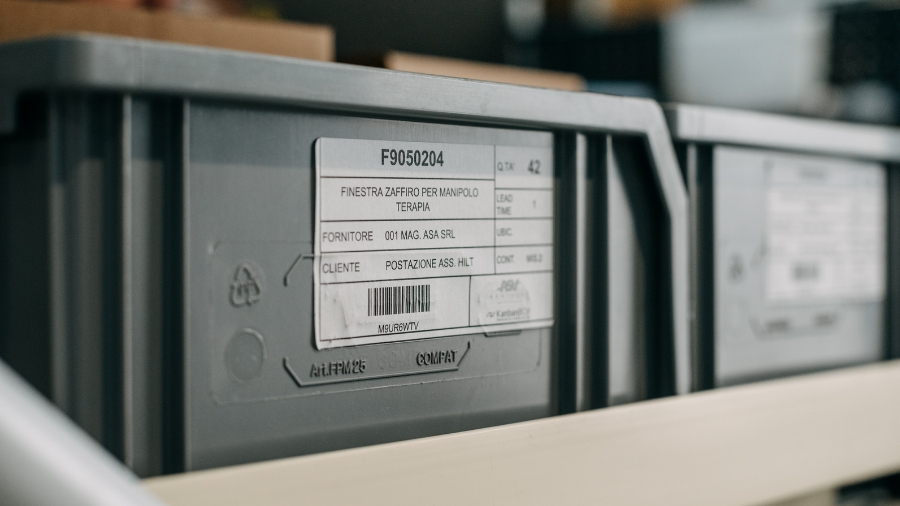
Each container in the supermarket has a kanban card attached. This card contains the necessary information to replenish a product: the product code and name, the quantity per container (in this case, 1 lamp), the process to which it must be delivered for completing the replenishment (finished goods supermarket), and the process responsible for replenishing it (the painting department).
When a product is picked up from the supermarket, the card is detached and delivered to the department responsible for replenishing it.
Step 3: Taking the semi-finished product and replenishing the finished product
Upon receiving the kanban card with the necessary information to replenish the red lamp, the painting department worker takes an assembled but unpainted lamp from the semi-finished goods supermarket, removes its kanban card, and delivers the kanban card to the assembly department (which will replenish the semi-finished product).
The worker then paints the lamp and, once finished:
- Places the finished product (the lamp) in a standard container
- Attaches to the container the kanban card received at the beginning of the replenishment process (the one detached from the depleted finished product)
- Delivers it (container, lamp, kanban card) to the finished goods supermarket.
Main rules of a kanban production system
- Production is pulled by demand (pull production system)
Each stage of processing is “pulled” by the subsequent stage. Production does not occur based on forecasts but only when a product or semi-finished item has been ordered or picked up from the warehouse (i.e., “depleted”) and needs to be replenished. - Whether the kanban card is attached or detached changes everything
Each product, semi-finished product, or material placed in a container is associated with a kanban card. If the card is attached to a container with material, it identifies the contents. If detached, it signals the need to replenish the product specified on the card and must be delivered to the department responsible for replenishing it. - The same kanban card must be applied to the replenished product container
When a product is consumed, the card is detached and sent to the department that will proceed with the replenishment. Once the product is replenished, the same card is applied to the replenished product container, signaling its availability.
- The kanban card must be detached when the container is emptied
The kanban card must be detached only when the container has been completely emptied. For example, imagine a container with 25 lamp bases, from which the operator takes one piece at a time during assembly. The kanban card, which indicates the initial quantity of 25 pieces, is removed only when the last component is taken, thereby signaling the need to replenish the stock. - Kanban production systems are not all the same
Kanban production systems can take many configurations depending on the type of product and the complexity of the production process. It can involve finished goods/semi-finished goods supermarkets or not, as well as multi-stage processing with simultaneous production in separate cells, batch replenishment policies, etc.
This is because it is a system with many different configurations, which must be carefully designed according to the specific production needs of the company where it is implemented.
Benefits of producing with kanban system
Switching from a push production system (based on sales estimates and prior schedules) to a pull production system with kanban system (pulled by demand) offers several advantages:
- Less inventory and waste
Producing only what is required, kanban reduces overproduction, optimizes resource use (including operator time), and reduces excessive inventory and related costs. - Greater flexibility
The kanban system allows for a quick response to changes in demand, redirecting production efforts where needed, without the constraints of rigid scheduling.
- Operational simplicity
A kanban system is very intuitive for operators, who simply need to read what they need to produce and to which department/area to deliver it. This makes operations more intuitive and accessible for all workers. - Speed and autonomy in starting replenishment activities
Operators no longer have to wait for production orders from a supervisor: receiving the kanban card serves as direct authorization to proceed, promoting timely replenishment and operational autonomy. - Regular flows and easy identification of issues
The flow becomes more consistent, as each activity is connected to the previous one. This allows for issues (e.g., bottlenecks, structural delays) to be visible, previously hidden by excessive stock, and enables prompt intervention to resolve them.
Limits of kanban production overcome by its digital evolution
While producing with kanban system is very effective for optimizing manufacturing and reducing waste, it has some limitations.
Manually managing kanban cards activities (e.g., collection and delivery) can be subject to human error, loss, and delays in communication between departments. Additionally, in complex environments or with high demand variability, the system can be difficult to manage, especially when workflows become more intricate.
For these and other reasons, many companies choose to produce with kanban system using its digital evolution, which integrates dedicated software, known as “Electronic Kanban Implementation Software,” alongside the physical flow.
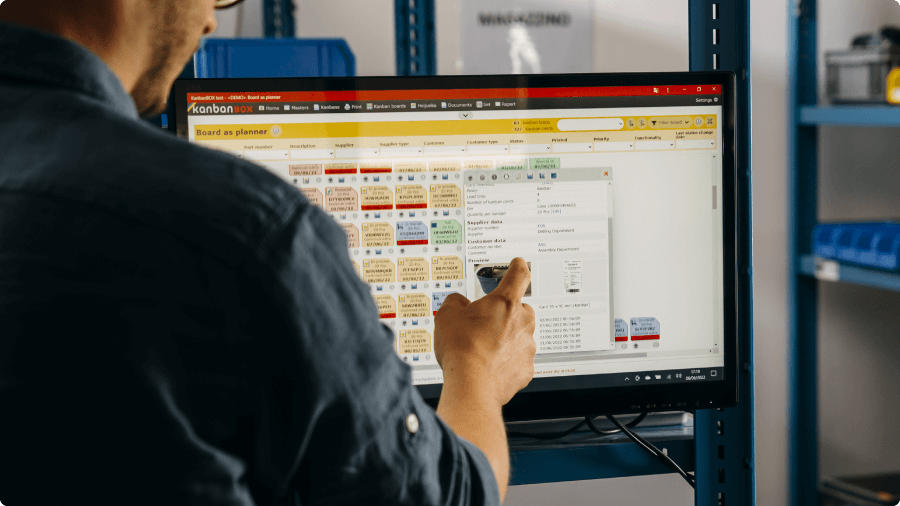
These systems allow:
- Real-time tracking of all system data, gathering useful statistics to maintain full control and visibility, also on workload and order progress
- Digital transmission of replenishment requests, eliminating the need for physical paper kanban cards (replaced by disposable cards or electronic labels)
- Management of complex flows with greater agility and precision, involving other actors in the supply chain, including plants and warehouses in different cities or states, other group companies, suppliers, subcontractors, and customers.
This results in significant advantages, including:
Producing with kanban system to optimize production
As seen, producing with kanban system offers numerous advantages, including reduced waste, optimized inventory, and a more responsive management system based on actual demand. This is made possible by its “pull” approach, which ensures that production is started only when needed, reducing the risk of overproduction and improving overall efficiency.
In its digital version, known as electronic kanban or e-kanban, kanban becomes even more powerful: digitalization allows real-time monitoring of flows, improved traceability, and reduced error risk, offering more agile and precise management.
Result: an optimized production process that is more efficient, flexible, and sustainable.
You can discover more about the advantages of electronic kanban for manufacturing companies here.
Do you want to implement a kanban production system, traditional or electronic?
Contact us: our industrial engineers are ready to guide you toward the best approach!
Our experts are ready to support you
Case studies
Sacchi | Electrical Supply Distribution
Sacchi uses KanbanBOX to offer its customers a kanban-based sales service, ideal for recurring supplies and supports long-term customer loyalty
Oleodinamica Marchesini | Hydraulic valves
Oleodinamica Marchesini has optimized its production flow management by implementing multi-process kanban and pull production
Robopac | Packaging machines
With KanbanBOX, Robopac achieved a more integrated, responsive, and digitalized supply chain thanks to the integration with both external suppliers and SAP
BCS | Agricultural Mechanization
BCS moved from push to pull through E-kanban for suppliers, production, and internal flows. They now manage 6000 kanban loops across 3 plants
El.Co. | Industrial Electrical Automation
El.Co. has simplified the maintenance of kanbans with e-kanban, which was previously so onerous that the number of parts managed by kanban had to be limited
Orotig | Welding Industry
Orotig has implemented sequential pull in the company, optimizing multi-process production scheduling and supplier integration with KanbanBOX
Rossi SpA | Gearmotors and Electric Motors
Rossi Spa has digitalized the existing production and move kanban, then integrated it with its own ERP, with Oracle Sequencer and with suppliers
Aptiv | High-tech automotive systems
From the introduction of kanban to the transition to e-kanban. The Lean Improvement journey of the largest manufacturer of electronic interconnection systems for the automotive sector
References