How to scale a kanban distribution system
What does “kanban distribution system” mean?
A kanban distribution system is a distribution system based on the kanban method, where material replenishment is automatically triggered by actual consumption.
It’s a simple yet highly reliable approach: each branch, distribution center, or external warehouse maintains a predefined stock level for each product, calibrated based on demand.
When stock levels fall below an agreed minimum threshold, the central plant automatically triggers replenishment, ensuring a continuous supply flow.
How a kanban distribution system works
Kanban distribution systems are based on the use of so-called kanban cards.
Each container supplied by the central facility and located at a branch, external warehouse, or distribution center is equipped with a paper card (the kanban card) attached externally. This card contains all the information needed for replenishment: product code, supplier (e.g., central warehouse or production plant), quantity per container, and client (the branch, warehouse, or distribution center where it must be delivered).
When the container is depleted (meaning it is emptied because the product has been used or sold), the kanban card is detached and set aside with others until the next delivery.
At that point, the collected cards are handed over to the carrier, who returns them to the central facility.
Once received, operators read the information on the cards to identify which products have been depleted across different locations and proceed with replenishment.
This allows for a continuous replenishment flow and keeps stock levels aligned with actual consumption.
Limitations of a “traditional” kanban distribution system
The system described above represents the traditional version of kanban distribution system, where paper cards are physically collected and returned during the next delivery.
While effective, this approach has several limitations:
- Manual handling of paper cards is prone to errors, such as lost cards, delays in collection, or physical wear and tear.
- There is a structural delay between when a container is emptied (which may happen shortly after a delivery) and when it is replenished (not at the next delivery, but the one after).
- The central facility lacks real-time visibility on stock levels. If there is a sudden spike in demand, it will only be detected at the next delivery when the accumulated cards are received. As a result, replenishment may lag behind actual demand.
- Scalability is limited. Managing a small number of cards is simple, but handling hundreds or thousands across multiple locations, possibly in different regions or countries, becomes complex and more error-prone.
Overcoming limitations with electronic kanban (e-kanban)
To address these limitations, more and more companies are adopting the digital evolution of the kanban distribution system: the electronic kanban system, or e-kanban.
The replenishment logic remains the same. The key difference lies in the digital management of information, enabled by dedicated e-kanban software.
One of the most important changes is how the replenishment signal is transmitted.
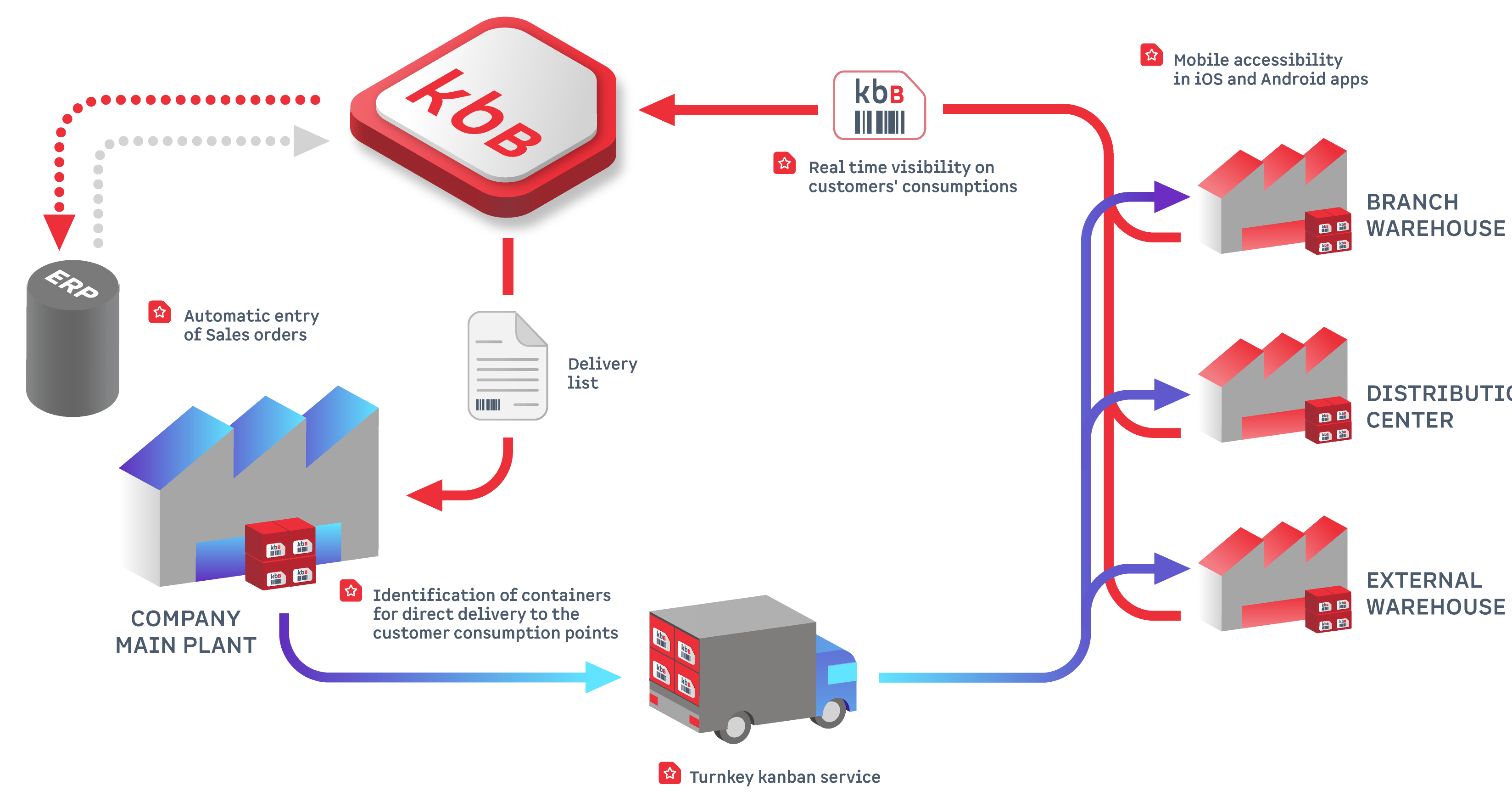
When a branch, external warehouse, or distribution center depletes a product, the operators no longer need to remove and store a physical card. Instead, they simply scan it (using a barcode scanner, handheld device, or smartphone) to transmit the signal instantly.
This means consumption data is transmitted in real time to the software and directly to the central facility, which can immediately trigger replenishment.
Alternatively, kanban cards can be replaced with electronic labels. In this case, signaling replenishment becomes even simpler: the operator just presses a button on the label.
In both cases, the system becomes far more responsive, accurate, and efficient. The signal no longer needs to be physically transported: it travels instantly across the entire network.
Benefits of e-kanban for the central facility or supplier
Adopting an e-kanban system for distribution brings significant advantages. Here are the main ones.
- Real-time order reception and lead time reduction
Thanks to instant transmission of replenishment signals, the time between consumption and replenishment is significantly reduced, shortening overall lead time. - Efficient order management and ERP integration
Automated order transmission and integration between the e-kanban system and the company’s ERP streamline daily operations, reduce manual work, and improve productivity while minimizing errors. - Full visibility of consumption and orders
The system provides real-time visibility into stock levels, consumption, orders, and deliveries across all locations, ensuring full control over the entire distribution network. - Data traceability and analytics
Every consumption, order, and delivery is automatically recorded and tracked, providing a complete history and more reliable data for analysis. - Automatic stock optimization
Based on consumption trends, the system can suggest when to increase or decrease stock levels at specific locations, helping manage demand fluctuations more effectively. - Optimized deliveries with milk-run
Organizing deliveries using milk-run logic improves transportation efficiency, reduces costs and waste, and increases delivery performance. - Standardization across multiple locations
The distribution process is standardized, reducing variability and errors while making the system more stable, scalable, and easy to replicate, even across different countries.
Benefits for branches, distribution centers, and external warehouses
Being supplied through an e-kanban system also significantly improves the experience of branches and internal customers.
- Simplified order management and reduced workload
Reordering becomes fast and intuitive, eliminating emails, phone calls, and manual entries while reducing operational effort. - Faster replenishment through instant order transmission
Orders are sent instantly, reducing lead time and making the replenishment flow faster and more efficient. - Transparency and visibility on stock
Each branch has real-time visibility into its own stock levels and order status, ensuring full control over local operations. - Better handling of demand peaks
Stock levels are dynamically adjusted based on actual consumption, making it easier to absorb demand spikes without disrupting operations. - Higher service reliability
A continuous and synchronized flow ensures more predictable and timely deliveries, improving overall service reliability.
Why it makes sense to adopt an e-kanban distribution system today
If your distribution still relies on tools like Excel, emails, or manual data entry, you’re likely already experiencing their limitations. Not just in efficiency, but especially in scalability.
Kanban distribution allows you to build a simple, stable flow aligned with real demand. With e-kanban, this model evolves further: processes are automated, systems are integrated, and the entire network remains under control, even as complexity increases.
The result is a system where consumption, orders, production, and deliveries work together in a continuous, synchronized flow.
If you want to understand how to apply this approach to your business and make your distribution truly scalable, the next step is simple:
analyze your current processes and identify where to improve.
Not sure where to start?
We can help
Case studies
Sacchi | Electrical Supply Distribution
Sacchi uses KanbanBOX to offer its customers a kanban-based sales service, ideal for recurring supplies and supports long-term customer loyalty
Oleodinamica Marchesini | Hydraulic valves
Oleodinamica Marchesini has optimized its production flow management by implementing multi-process kanban and pull production
Robopac | Packaging machines
With KanbanBOX, Robopac achieved a more integrated, responsive, and digitalized supply chain thanks to the integration with both external suppliers and SAP
BCS | Agricultural Mechanization
BCS moved from push to pull through E-kanban for suppliers, production, and internal flows. They now manage 6000 kanban loops across 3 plants
El.Co. | Industrial Electrical Automation
El.Co. has simplified the maintenance of kanbans with e-kanban, which was previously so onerous that the number of parts managed by kanban had to be limited
Orotig | Welding Industry
Orotig has implemented sequential pull in the company, optimizing multi-process production scheduling and supplier integration with KanbanBOX
Rossi SpA | Gearmotors and Electric Motors
Rossi Spa has digitalized the existing production and move kanban, then integrated it with its own ERP, with Oracle Sequencer and with suppliers
Aptiv | High-tech automotive systems
From the introduction of kanban to the transition to e-kanban. The Lean Improvement journey of the largest manufacturer of electronic interconnection systems for the automotive sector
References