How to Solve the Problem of Lost Kanban Cards
The traditional kanban system (that is, a non-digital system) is simple, visual, and effective, but it has a significant weakness: the management of paper kanban cards, which can easily be lost. A lost, forgotten, or damaged kanban card can interrupt the transmission of the replenishment signal.
When the flow of information depends on the physical movement of kanban cards, even a minor oversight can cause delays, material shortages, and production downtime. To make the process more reliable, companies can improve how physical cards are managed or completely eliminate the need to collect them by adopting a digital system. Let us explore both options.
Why Losing Kanban Cards Is a Problem
Lost kanban cards are one of the most common issues in traditional kanban systems based on paper cards. When a card is lost, the replenishment signal does not reach the warehouse, production department, or supplier responsible for replenishing the material.
As a result, the component may not be reordered, the request may be processed late, and, in the most critical cases, the production line may stop because the required material is unavailable.
The problem therefore goes beyond the cost or time required to reprint the kanban card. What is compromised is the entire information flow connecting material consumption with replenishment. Without a reliable signal, the kanban system can no longer effectively synchronize materials and production, directly affecting operational continuity, replenishment punctuality, and the overall efficiency of the process.
Why Do Kanban Cards Get Lost?
Kanban cards get lost because, in a traditional kanban system, the replenishment signal is linked to a physical paper card that must be removed, collected, transported, and delivered correctly. Every step introduces a potential point of failure: the card may remain inside the empty container, fall during material handling, be left at the wrong workstation, or reach the person responsible for replenishment too late. The risk increases when the system manages many part numbers, multiple shifts, distant production areas, or external suppliers.
A lack of standardization also contributes to the problem. Unidentified collection points, irregular collection schedules, insufficient controls, and unclear responsibilities make the flow less reliable. Operational changes create an additional challenge. When a kanban loop is resized, the existing cards must be collected and replaced to show the correct number of containers in circulation (for example, 1 of 5 or 1 of 6). Some outdated versions may remain in use and generate signals that are no longer consistent with the updated kanban sizing.
How to Prevent Kanban Cards from Getting Lost
Several basic measures can be introduced to reduce the risk of losing kanban cards:
- Define clearly visible collection points
- Assign clear responsibilities
- Use dedicated kanban card holders
- Set fixed collection times
- Periodically check that the number of cards matches the expected quantity.
These practices improve process discipline, but they do not eliminate the system’s dependence on the physical movement of kanban cards. As the system grows, the work required to collect, check, reprint, and update the cards also increases.
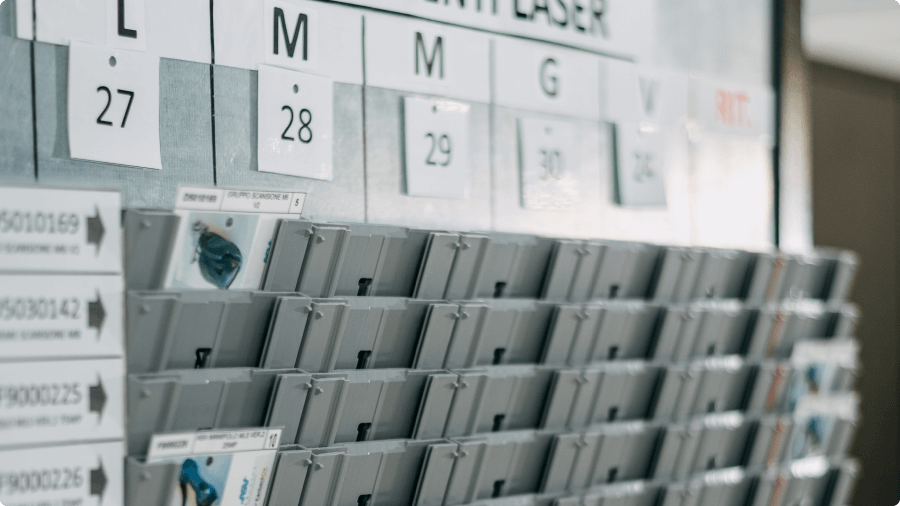
For this reason, an increasing number of companies are switching to the digital version of the kanban system, known as electronic kanban or e-kanban.
Let us take a closer look at what electronic kanban is and how it solves the problem of lost kanban cards.
What Is Electronic Kanban and How Does It Solve the Problem of Lost Kanban Cards?
Electronic kanban is the digital version of a traditional kanban system. It is implemented through a dedicated application known as electronic kanban software or e-kanban software.
Using this software, a company can digitally manage the consumption, replenishment, production, and material movement signals within its kanban system, without requiring the physical delivery of kanban cards. Here is how the process works.
How Is the Replenishment Signal Transmitted in an Electronic Kanban System?
As you know, kanban cards are reusable in a traditional kanban system. When a container becomes empty, the card is removed and delivered to signal that the material needs to be replenished. The same card is then attached to the newly refilled container and returned to circulation.
In an electronic kanban system, each card is associated with a unique identification code and is used for only one replenishment cycle.
- When the container is emptied, the operator scans the kanban card using a smartphone, handheld scanner, or another scanning device and then discards it.
- The scan is immediately recorded in the software, which detects that the material has been depleted and needs to be replenished.
- The system then creates a new kanban card for the same material, assigns it a new unique identification code, and digitally transmits it to the supplying process, whether internal or external to the company.
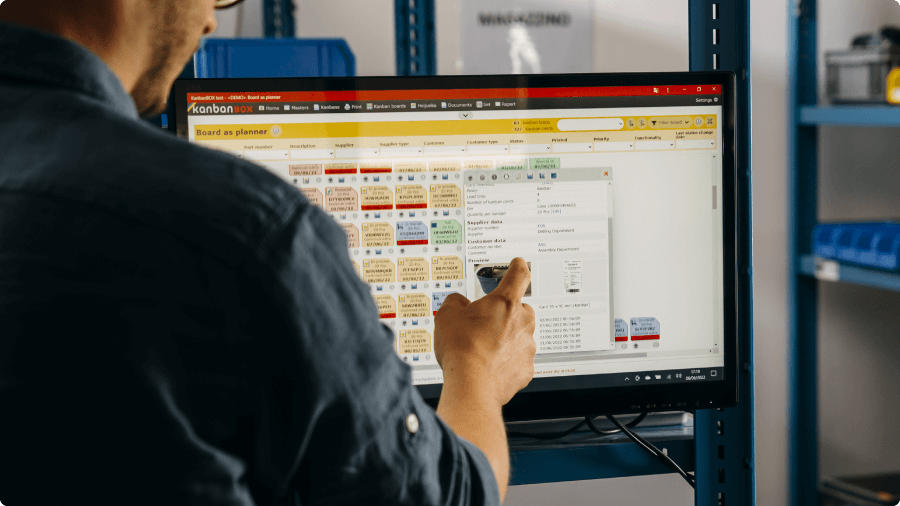
- The person responsible for the supplying process can view the new replenishment request and print the new card from a digital kanban board, accessible from a PC, production monitor, or tablet.
- Once the new container has been prepared, the supplier attaches the newly printed kanban card and delivers the material to the point of use.
Because each kanban card is unique, the software can individually track its creation, scans, status changes, and complete history without requiring the physical collection and redelivery of the card.
What Are the Benefits of Electronic Kanban for Managing Kanban Cards?
In an electronic kanban system, scanning kanban cards makes it possible to track them digitally. Each scan records material consumption and automatically moves the signal to the next stage, such as “to be replenished,” “in preparation,” “shipped,” or “available.” Kanban card tracking therefore makes it possible to reconstruct the logical position of each signal and the history of all completed operations.
Please note: kanban tracking does not mean physically locating a card using GPS. It means knowing which event was recorded, who performed it, when it occurred, and which stage of the kanban cycle the material has reached.
Let us examine the benefits of digitizing the transmission of replenishment signals and how electronic kanban helps solve the problem of lost kanban cards.
1) Paper Kanban Cards No Longer Need to Be Collected and Delivered
With digital tracking, kanban cards no longer need to be physically collected and delivered to the relevant supplier. This eliminates the risk of cards being lost, mixed up, or damaged. It also reduces non-value-added activities, such as periodically walking around the production lines to collect cards, sorting them, and delivering them to the different people responsible for replenishment.
The benefit is not only operational. The system records the signal immediately, allowing the replenishment process to begin sooner. Digitalization therefore preserves the simplicity of the kanban method while making the information flow faster and more traceable.

2) Kanban Cards Do Not Need to Be Reprinted After Every Resizing
Kanban sizing must be updated when material consumption, replenishment lead times, container quantities, service levels, or supply conditions change. In a traditional system, changing the number of kanbans often means reprinting the cards, collecting those already in use, and ensuring that no outdated cards remain in circulation. This process takes time and can generate errors, especially when many kanban loops are involved.
With electronic kanban, this activity is no longer necessary. Each kanban card is unique and, once its replenishment cycle has been completed, the system automatically generates new cards according to the updated parameters.
This makes it easier to adapt kanban sizing to actual consumption and encourages more frequent reviews. The system can evolve without turning every change into a manual process of collecting, replacing, and checking cards.
3) The Number and Status of Kanban Cards in Circulation Are Always Available
One of the main benefits of tracking is the ability to know the status of every kanban card at any time. From a digital kanban board, users can verify which cards have been generated, which replenishment requests still need to be accepted, and which replenishment cycles have been completed.
This visibility helps users distinguish between an actual material shortage and a simple delay in recording or completing a process stage. When an anomaly occurs, there is no need to physically search for the card among containers, collection points, or workstations. Users can consult the event history to determine when the most recent scan occurred and which user performed it.
Tracking also makes it easier to manage priorities, delays, and bottlenecks because signals can be sorted and filtered. Kanban therefore becomes not only a replenishment method but also an operational tool for controlling material flows.
With e-kanban software, electronic kanban helps overcome the productivity limitations of the manual kanban method, including limited process visibility.
4) The Inventory Function Keeps Kanban Cards and Containers Aligned
The inventory function in an electronic kanban system makes it possible to systematically verify the correspondence between kanban cards, physical containers, and the status recorded in the software. During an inventory check, operators can scan the cards found in a specific area and compare them with those the system expects to find there. This makes it easier to identify missing containers or kanban cards associated with incorrect locations. The inventory function therefore provides a dedicated control for verifying that the kanban system is operating correctly.
When performed regularly, this check keeps the physical process aligned with the digital data and prevents minor inconsistencies from accumulating over time. Traceability makes the system more reliable and helps users quickly restore the correct operating conditions.
Eliminate the Risk of Losing Kanban Cards
Do you want to:
- Solve the problem of lost kanban cards
- Digitize the transmission of replenishment signals
- Eliminate the manual collection of kanban cards
- Monitor the status of every kanban card, order, and replenishment request in real time
… contact us for a KanbanBOX demo!
We will show you how to create an efficient and effective electronic kanban system aligned with your operational requirements!
Contact us for a free consultation
Case studies
Sacchi | Electrical Supply Distribution
Sacchi uses KanbanBOX to offer its customers a kanban-based sales service, ideal for recurring supplies and supports long-term customer loyalty
Oleodinamica Marchesini | Hydraulic valves
Oleodinamica Marchesini has optimized its production flow management by implementing multi-process kanban and pull production
Robopac | Packaging machines
With KanbanBOX, Robopac achieved a more integrated, responsive, and digitalized supply chain thanks to the integration with both external suppliers and SAP
BCS | Agricultural Mechanization
BCS moved from push to pull through E-kanban for suppliers, production, and internal flows. They now manage 6000 kanban loops across 3 plants
El.Co. | Industrial Electrical Automation
El.Co. has simplified the maintenance of kanbans with e-kanban, which was previously so onerous that the number of parts managed by kanban had to be limited
Orotig | Welding Industry
Orotig has implemented sequential pull in the company, optimizing multi-process production scheduling and supplier integration with KanbanBOX
Rossi SpA | Gearmotors and Electric Motors
Rossi Spa has digitalized the existing production and move kanban, then integrated it with its own ERP, with Oracle Sequencer and with suppliers
Aptiv | High-tech automotive systems
From the introduction of kanban to the transition to e-kanban. The Lean Improvement journey of the largest manufacturer of electronic interconnection systems for the automotive sector
References