How to Improve Visibility in a Kanban System
The kanban method is a simple and intuitive way to manage material replenishment, but traditional kanban systems can present a significant challenge: limited visibility and control.
A manual kanban system works well when material flows are simple, departments are close to one another, and the number of kanban cards is limited. However, as the number of part numbers, suppliers, plants, or demand fluctuations increases, monitoring the system becomes more difficult. To understand the current status of materials, employees may need to physically check kanban boards, collect cards, or ask operators for updates.
The result is often partial and delayed visibility across purchasing, production, and material handling processes. Managers may not know exactly which containers are available, which are being replenished, which replenishment orders are late, or where a problem is occurring.
The issue is not the kanban method itself, which remains an effective way to manage pull-based material flows. The limitation lies mainly in the manual and paper-based way information is transmitted and updated.
Improving control therefore means making the kanban signal more reliable, accessible, and timely without losing the operational simplicity of the pull system. Let’s find out what causes this problem and how to improve visibility in a Kanban System.
Why Is Visibility Limited in Traditional Kanban Systems?
Limited visibility in a traditional kanban system is primarily caused by the separation between the physical material flow and the information flow.
Materials move between production lines, warehouses, manufacturing processes, and suppliers, while information is often transmitted through kanban cards, collection boxes, physical boards, emails, or Excel spreadsheets.
Every manual step can introduce delays, errors, or missing information. A kanban card can be lost, left at a workstation, moved without updating the board, or collected only at the end of a shift.
Visibility in a kanban system is also typically local. Employees standing in front of a supermarket or kanban board can see the current situation, while purchasing, planning, logistics teams, and external suppliers may receive the same information much later.
The problem becomes more significant as the number of part numbers, containers, departments, plants, and supply chain partners increases.
Under these conditions, it becomes difficult to:
- Reconstruct historical material consumption
- Identify the causes of a stockout
- Verify whether replenishment lead times are being respected
- Identify delays and bottlenecks
- Determine whether the current kanban sizing still reflects actual demand.
How to Improve Kanban Visibility and Control Through Standardization
One way to improve control and visibility in a kanban system is to introduce clear and consistent operating standards.
- Each kanban card should have a defined location, an assigned responsibility, a specific collection frequency, and clear rules for managing delays, urgent requests, and abnormalities.
- Physical kanban boards should be updated at predefined intervals and organized using clearly identifiable statuses such as Available, To Be Replenished, In Progress, and In Delivery.
- Periodic audits should also be performed to verify that kanban cards, containers, and physical inventory quantities are aligned.
- Companies can introduce a shared record for tracking consumption, stockouts, and replenishment lead times.
- An escalation procedure can also define who should be notified, in what sequence, and through which communication channel when a replenishment signal is not processed within the expected time.
These practices reduce variability and create a more disciplined kanban process.
However, they still require continuous manual activities. As the kanban system grows, more time is required to collect data, consolidate information, and distribute updates to people who cannot directly access the physical kanban board.
For this reason, many companies are addressing visibility and control limitations by digitizing their kanban systems.
How to Improve Kanban Visibility and Control Through Digitalization
To overcome the limitations of manually managed information, companies can move from traditional kanban to electronic kanban.
Electronic kanban (also known as digital kanban or e-kanban) is the digital evolution of a traditional kanban system. It connects the physical flow of materials with dedicated electronic kanban software.
The pull methodology and replenishment logic remain the same. What changes is the way consumption and replenishment signals are recorded, transmitted, shared, and updated.
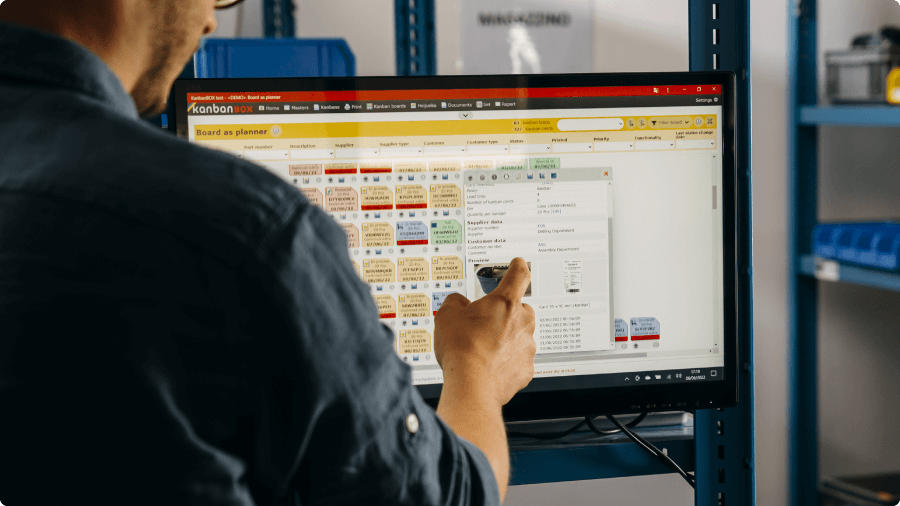
An e-kanban software platform provides a digital kanban board containing the kanban cards within the system and their main information, including part number or material, supplier, customer, quantity, container, current replenishment status. Statuses can indicate, for example, whether a container is available, consumed, waiting for replenishment, in production, or in delivery.
This allows employees involved in the process to check material status in real time without physically collecting kanban cards or manually checking individual workstations.
How Are Kanban Cards Tracked in an Electronic Kanban System?
In an electronic kanban system, each kanban card has a unique identification code and is associated with a specific replenishment cycle.
When a container is emptied, the operator scans the barcode on the kanban card and records the consumption.
The scan is immediately registered in the e-kanban software together with the date, time, and other information required for traceability. The system then generates a new kanban card for the same material with a new unique identification code.
The process responsible for replenishment automatically receives the signal through the software.
From the dedicated software interface, the internal or external supplier can see the new replenishment request, prepare the material, and print the new kanban card to be attached to the replenished container.
Digitizing the kanban signal therefore allows the replenishment request to be recorded and transmitted in real time, eliminating the need to manually collect, transport, sort, or redistribute physical kanban cards.
The pull methodology remains unchanged, while the status of materials becomes accessible at any time.
Electronic kanban therefore provides greater transparency, complete traceability of material movements, and better control over complex kanban systems involving multiple part numbers, departments, plants, or suppliers.
The data collected can also be used to monitor replenishment lead times, delays, consumption, and abnormalities, helping improve the reliability of the overall material flow.
Benefits of Electronic Kanban for Visibility and Control
Real-Time Visibility Into Material Status
Electronic kanban makes it possible to know the current status of each material at any time.
Through a shared dashboard, users can identify which containers are available, which have been consumed, which need to be replenished, and which replenishment orders are already being processed or delivered.
Information is no longer restricted to the physical kanban board located on the shop floor.
Instead, production, logistics, purchasing, and other stakeholders can access the same up-to-date information regardless of their physical location.
Kanban Card Traceability
Every kanban scan is recorded by the software. This makes it possible to reconstruct the entire replenishment cycle, from the moment a material is consumed to the delivery of the replenished container.
This level of traceability helps companies identify delays, bottlenecks, and abnormalities while reducing problems caused by kanban cards being lost, forgotten, or handled without leaving a trace. A great hepl to improve visibility in a kanban system.
Immediate Replenishment Signals, Including to External Suppliers
When an operator scans the kanban card associated with an empty container, the replenishment signal can be immediately transmitted to the supplying process. There is no need to physically collect the card, deliver it to another department, or manually enter a replenishment order.
The request becomes immediately visible to the relevant internal or external supplier, reducing communication time and the risk of errors or delays.
Centralized Control of Kanban Flows
E-kanban software centralizes replenishment requests within a single platform. Users can organize and filter kanban cards according to criteria such as priority, material or part number, department, supplier, plant, replenishment status.
This allows managers to monitor even complex kanban systems without continuously visiting production lines, supermarkets, and warehouses to understand the current situation.
Faster Identification of Kanban Problems and Exceptions
Dashboards, notifications, and automatic alerts can make abnormalities immediately visible. These may include late replenishment orders, unavailable materials, replenishment lead times above the expected standard, potential stockout risks.
Managers can therefore intervene before a problem results in a production stoppage, missed delivery, or excessive inventory accumulation.
Reliable Data for Continuous Kanban Improvement
Electronic kanban does more than provide a real-time view of the system. It also creates historical data on material consumption, replenishment orders, and lead times.
These data can be used to evaluate kanban loop performance, verify whether agreed lead times are being respected, investigate the causes of bottlenecks, and update kanban sizing according to actual material consumption.
Visibility and control therefore become not only operational but also data-driven and oriented toward continuous improvement.
Do you want to understand how it works? Ask for a KanbanBOX demo
If your kanban system works operationally but does not provide enough visibility into materials and replenishment status, you do not necessarily need to replace the pull methodology. Instead, you can digitize the way kanban signals are generated, transmitted, shared, tracked, and analyzed.
KanbanBOX is an electronic kanban software developed to improve visibility and control across purchasing, production, and material handling flows without disrupting existing pull processes.
KanbanBOX can help companies address common problems in traditional kanban systems, including:
- Lost kanban cards
- Excessive replenishment lead times
- Excess inventory and stockout risks
- Difficulties involving suppliers and external partners
- Limited visibility across multi-stage processes
- Fragmented information across departments, plants, and systems.
If you want to understand how electronic kanban can improve visibility and control in your material flows, request a free KanbanBOX demo.
Request a Free KanbanBOX Demo
Our consultants, with expertise in Lean processes and material flow management, will analyze your requirements and show you how KanbanBOX can be applied to your purchasing, production, and material handling processes.
Case studies
Sacchi | Electrical Supply Distribution
Sacchi uses KanbanBOX to offer its customers a kanban-based sales service, ideal for recurring supplies and supports long-term customer loyalty
Oleodinamica Marchesini | Hydraulic valves
Oleodinamica Marchesini has optimized its production flow management by implementing multi-process kanban and pull production
Robopac | Packaging machines
With KanbanBOX, Robopac achieved a more integrated, responsive, and digitalized supply chain thanks to the integration with both external suppliers and SAP
BCS | Agricultural Mechanization
BCS moved from push to pull through E-kanban for suppliers, production, and internal flows. They now manage 6000 kanban loops across 3 plants
El.Co. | Industrial Electrical Automation
El.Co. has simplified the maintenance of kanbans with e-kanban, which was previously so onerous that the number of parts managed by kanban had to be limited
Orotig | Welding Industry
Orotig has implemented sequential pull in the company, optimizing multi-process production scheduling and supplier integration with KanbanBOX
Rossi SpA | Gearmotors and Electric Motors
Rossi Spa has digitalized the existing production and move kanban, then integrated it with its own ERP, with Oracle Sequencer and with suppliers
Aptiv | High-tech automotive systems
From the introduction of kanban to the transition to e-kanban. The Lean Improvement journey of the largest manufacturer of electronic interconnection systems for the automotive sector
References