Tracciabilità dei lotti con il kanban: è possibile? Guida pratica
Short answer
Yes, lots can be traced in a kanban system too, but the paper card alone is not enough. The kanban card is designed to signal how much and when to reorder, not which lot is circulating: to achieve traceability, it must be combined with strict FIFO rules, a container dedicated to a single lot and manual recording of lot number, dates and usage.
This works as long as part numbers and volumes are limited: when they grow, or when a customer asks you to trace a lot back within a few hours, paper records become the weak link, and this is where electronic kanban makes the difference.
Why lots are a problem in kanban systems
Kanban is essentially a material replenishment system, not an identification system. The card is linked to a part number and a fixed quantity, and it goes back into circulation unchanged at every cycle: the same card that travels with lot A today will travel with lot B two weeks from now.
Lot traceability, on the other hand, is the ability to reconstruct, for each lot, which supplier it came from, when, which finished products it was used in and which customers it was shipped to. The two approaches do not contradict each other, but they do not overlap either: basic kanban keeps no record of which lot it accompanied.
Lot traceability becomes essential in three cases:
- Standards and certifications: ISO 9001 (clause 8.5.2) requires identification and traceability where it is a requirement; in the automotive industry, IATF 16949 makes it mandatory in practice; in the food industry it is required by Regulation (EC) No 178/2002; in the medical sector by Regulation (EU) 2017/745.
- Customer requests: an OEM (Original Equipment Manufacturer) or a main contractor may ask to know within a few hours which deliveries contain a suspect component.
- Non-conformity management: without traceability, a defect in one lot forces you to quarantine or recall all the material produced over a period of time, not just the affected material.
How to trace lots with kanban: 4 practical methods
There are 4 practical methods for tracing lots with kanban cards, and they can be combined. Keep in mind, however, that the more rigorous they are, the more traceability improves, but the more manual work they require.
Method 1: one container, one lot
Each kanban container holds material from a single lot, never topped up with a different lot. The lot number is written on a label applied to the container (or on the supplier’s delivery note attached to the container), not on the card, which remains reusable.
Pros: simple, no additional log needed to identify the material.
Limitation: if the supplier’s lot is larger than the container, you need more labels and more care in storage.
Method 2: strict FIFO in the supermarket
Gravity racks, flow lanes or picking rules that ensure the material stored longest is used first guarantee that lots are consumed in order of arrival. This way, knowing the arrival dates, you can estimate fairly accurately when a lot entered production.
Pros: nothing needs to be written down, because the order is determined by the physical layout. It also reduces the risk of having expired or deteriorated material in stock.
Limitation: it is an estimate, not a record. A single out-of-sequence pick invalidates the entire estimate.
Method 3: line-side consumption log
When operators open a new container, they record on a form (or in an Excel sheet) the part number, lot number, date, time and production order or shift.
Pros: it is the only method that creates a real link between component lot and finished product.
Limitation: it depends on operator accuracy and requires data to be re-entered before it can be consulted.
Method 4: card with a marker-pen lot field (or document pocket)
Some companies add an erasable field to the card, or a pocket to hold the delivery note of the lot in use.
Pros: it costs almost nothing, and operators can see immediately, at the line, which lot they are using. It is also useful for in-process quality checks.
Limitation: the information is erased at the next cycle, so no history is kept. Useful for identification, not for traceability.
Where traceability breaks down with kanban cards
Even with the best methods, there are points where the traceability chain breaks. The main ones are listed below.
| Critical point | What happens | Consequence |
|---|---|---|
| Topping up a container with a different lot | Two lots get mixed in the same container | Impossible to tell which lot ended up in which product |
| Out-of-sequence FIFO picking | A newer lot is used before an older one | Estimated consumption dates become wrong |
| Incomplete or illegible log | The operator forgets or miswrites the lot and time | A gap in the chain, discovered only when it is needed |
| Data scattered on paper or across files | Forms on the shop floor, Excel in the office, delivery notes in the archive | Reconstructing a lot takes hours or days of searching |
| Lost or duplicated card [link] | The kanban loop breaks or splits in two | The card-container-lot link is lost as well |
| Growing numbers of part numbers and lots | More items, more suppliers, smaller lots | The manual recording workload becomes unsustainable |
The clearest sign that the system has reached its limit is time: if answering “which deliveries did lot X end up in?” takes more than a few hours, traceability exists on paper but not in practice.
Making traceability possible with electronic kanban
As you may already have heard, kanban does not only exist in its “traditional” form, with paper cards reused across replenishment cycles. For several years now there has also been electronic kanban (or e-kanban), the digital version of the kanban method in which the information on the cards is managed through software.
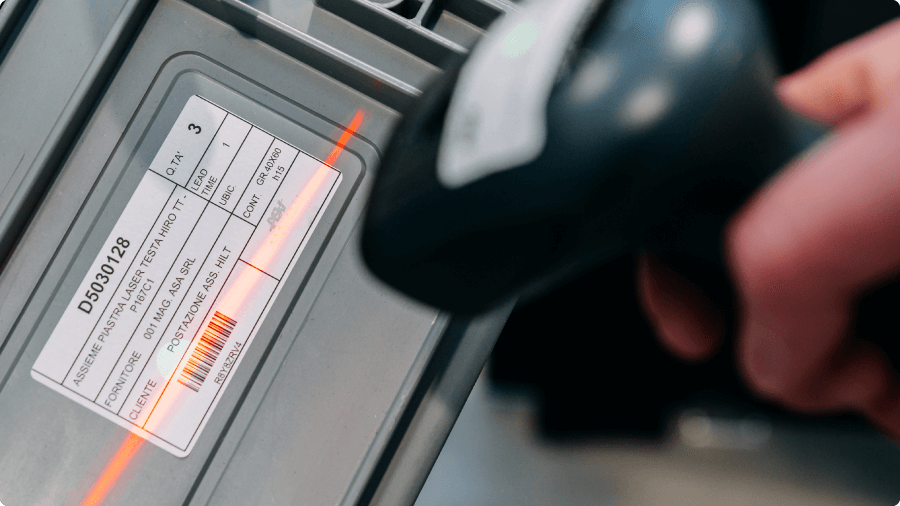
It works the same way as the traditional version: you reorder only when a container is empty. The difference lies in the card. In addition to part number and quantity, each card carries a barcode or QR code that identifies it uniquely, like a licence plate: even two cards for the same item have different codes.
When the container is empty, the operator no longer takes the card to the board but scans it with a smartphone or barcode reader, and the replenishment request is sent digitally to the supplier, whether internal or external. Every scan is recorded with date and time.
It is precisely this history that makes traceability possible, in three ways:
- Automatic history: each card has a unique identifier, and the software records when it was released, accepted by the supplier, shipped, received and consumed. Nothing needs to be transcribed or re-entered.
- Automatic reconstruction of links. In the KanbanBOX electronic kanban software, for example, the Track and Trace module links component cards to finished product cards by comparing the time windows of component consumption with the processing periods of a finished product.
This makes it possible to trace both the finished products that may contain a defective component and the components that may have been used in a disputed finished product. - Supplier identification. If suppliers are connected to the electronic kanban system (through purchasing kanban), information such as shipment number and delivery date is also recorded by the software. This way, traceability starts not only from material consumption, but from its arrival at the plant.
The physical traceability methods described in the previous section remain useful: one lot per container and FIFO make the electronic data even more accurate. The difference is that recording no longer depends on filling in a form, but happens with a simple scan.
Traceability in traditional kanban vs electronic kanban
| Aspect | Traditional kanban (not digitised) | Electronic kanban (e-kanban or digital kanban) |
|---|---|---|
| Card identification | Not unique: all data is the same at every cycle (e.g. part number and quantity) | Unique: each card carries a unique identifier in the form of an alphanumeric code and/or barcode, QR code or RFID |
| Recording of dates and steps | Manual, on forms or in Excel | Automatic at every scan |
| History | Only if someone records and keeps it | Always available in the software |
| Link between component and finished product | Reconstructed by hand from logs | Automatic report, in both directions |
| Supplier involvement | Separate delivery notes and documents | Shipments recorded on the same cards |
| Time to respond to a recall | Hours or days | Minutes |
| Dependence on operator discipline | High | Low: just scan the card |
Example: what happens when a supplier reports a defective lot
Imagine a mechanical engineering company that manufactures valve assemblies, Valvole Srl. Its gasket supplier (Guarnizioni Spa) reports that lot L-2417 has a compound defect. Valvole Srl wants to know where the components from that lot were used.
With a traditional kanban system
- Valvole Srl’s quality manager looks for the delivery note for lot L-2417 to find out when it arrived.
- They retrieve the container opening logs for that period, if they were filled in.
- They cross-check the dates with production orders and then with customer shipments.
- If a log is missing, as a precaution they quarantine all material produced in those weeks.
Time required: hours, with no guarantee of finding the information needed.
With electronic kanban
- Valvole Srl’s quality manager identifies the card that accompanied lot L-2417 (from goods receipt or from the container label).
- They run the traceability report on the component card.
- They get the list of finished product cards produced while that container was being consumed.
- They quarantine only those finished product lots and give the customer a precise scope.
Time required: a few minutes, with clearly defined answers.
h2 style=”color: #cb333b;”>Checklist: does your traceability system hold up?
Answer these questions about your current system. Every “no” is a point where the chain can break.
- Does each container hold only one lot?
- Is the lot number visible on the container until it is fully consumed?
- Does picking always follow FIFO (First-In, First-Out), even on night shifts and during peaks?
- Are the opening and consumption of each container recorded with date and time?
- Can the history be consulted in one place, without having to re-enter data?
- Can you link a component lot to finished products in less than an hour?
- Can you also go the other way, from finished product to components?
If you answered “no” to three or more questions, it is worth considering a system that records this data automatically. Book a KanbanBOX demo to see how Track and Trace works on your own part numbers.
Domande frequenti
Yes. Kanban handles reordering, traceability and identification: they work together, provided you add rules (one lot per container, FIFO) and a way to record consumption.
You can, but the card goes back into circulation at every cycle and the data is lost. It is better to write the lot on the container and separately record when the container is opened and finished.
No. FIFO lets you estimate when a lot was consumed, but a single out-of-sequence pick makes the estimate unreliable. It needs to be combined with recording.
It is the digital version of the kanban system: same cards and same pull logic, but each card has a unique code and every status change (available, in process, to be replenished) is recorded in software. To learn more, read: What is electronic kanban.
No. Barcodes or QR codes read with smartphones or scanners are enough. RFID automates reading and is useful for high volumes.
Hai qualche domanda?
Case studies
Sacchi | Electrical Supply Distribution
Sacchi uses KanbanBOX to offer its customers a kanban-based sales service, ideal for recurring supplies and supports long-term customer loyalty
Oleodinamica Marchesini | Hydraulic valves
Oleodinamica Marchesini has optimized its production flow management by implementing multi-process kanban and pull production
Robopac | Packaging machines
With KanbanBOX, Robopac achieved a more integrated, responsive, and digitalized supply chain thanks to the integration with both external suppliers and SAP
BCS | Agricultural Mechanization
BCS moved from push to pull through E-kanban for suppliers, production, and internal flows. They now manage 6000 kanban loops across 3 plants
El.Co. | Industrial Electrical Automation
El.Co. has simplified the maintenance of kanbans with e-kanban, which was previously so onerous that the number of parts managed by kanban had to be limited
Orotig | Welding Industry
Orotig has implemented sequential pull in the company, optimizing multi-process production scheduling and supplier integration with KanbanBOX
Rossi SpA | Gearmotors and Electric Motors
Rossi Spa has digitalized the existing production and move kanban, then integrated it with its own ERP, with Oracle Sequencer and with suppliers
Aptiv | High-tech automotive systems
From the introduction of kanban to the transition to e-kanban. The Lean Improvement journey of the largest manufacturer of electronic interconnection systems for the automotive sector